Skip to main content Skip to navigation
Washington State University Innovation for Sustainable Energy

Haskel Gas Booster Pressure Test

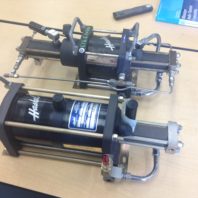
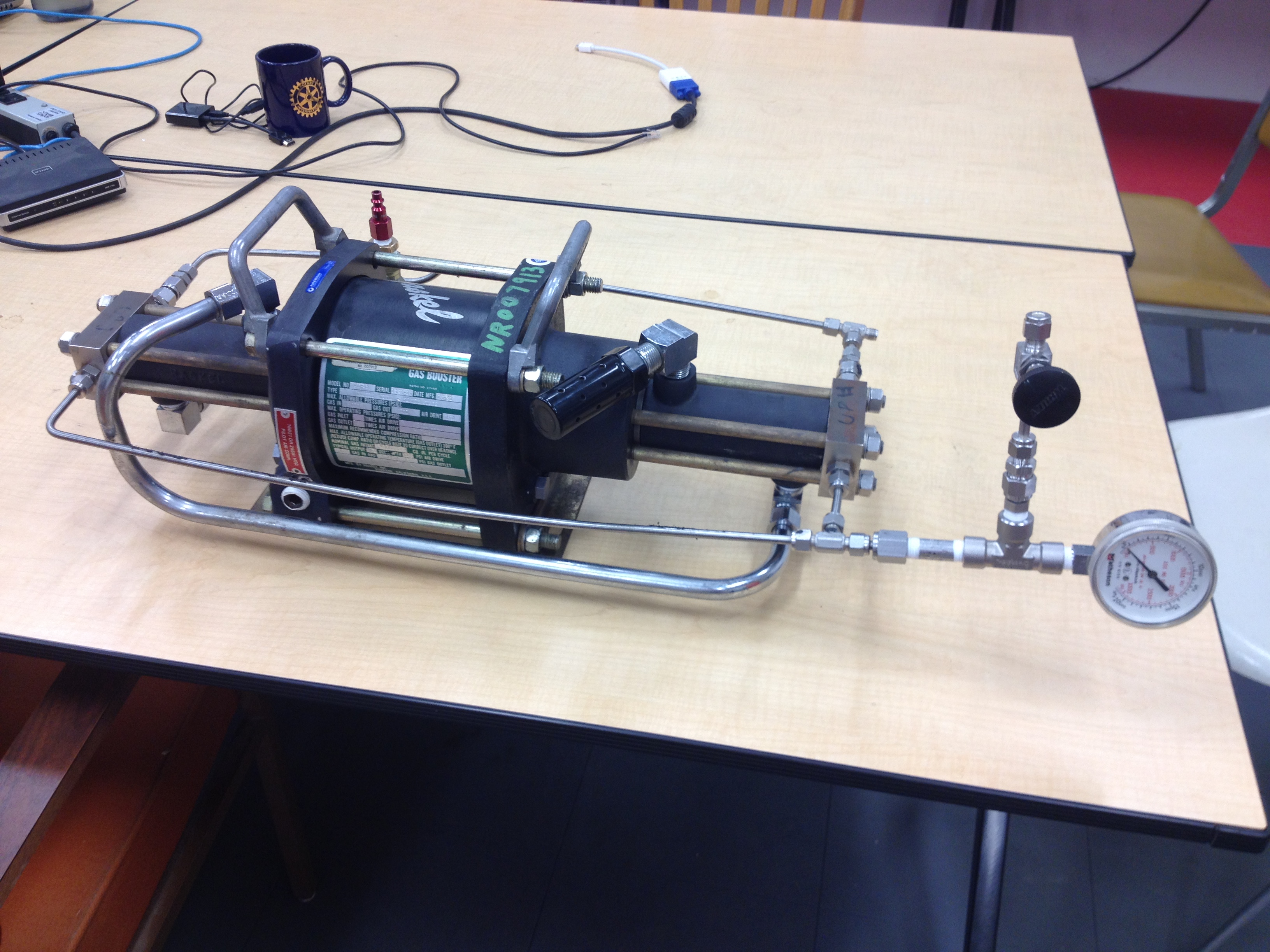
Of the two gas boosters (compressors) we have, we have successfully pressure tested one of them.  The Haskel AGD-15 has been tested for stall pressure using nitrogen.  This gas booster is a double acting, single state mechanism used to compress a gas to high pressure with only compressed air as a power source.

Our building’s compressed air was used to drive the unit at 90psi.  The nitrogen inlet pressure was at 70psi.  The nitrogen outlet was a high-pressure pipe connected to a vent valve and a pressure gauge.  To test for stall pressure, we left the outlet valve closed.  After only a few seconds, we were able to achieve 1400psi at the gauge (expected stall pressure was 1420psi).  This implies that the flow rate will be similar to expected when not pumping to stall.    However, the output pressure fluctuated significantly: the device would pump once and get to stall pressure.  Then it would pause and the pressure would drop to about 1100psi.  At this point it would pump again up to 1400psi.  This was in part due to the building’s air supply having inadequate flow.  Whenever the gas booster pumped, the building air pressure would drop down to 60 or 70 psi and struggle to rise again.

Further testing will require a larger air compressor unit.  Now, we need to find whatever is leaking in our gas booster (probably the one-way valves which are quite old).  We will also prepare to test our Haskel AG-152 model which has a stall pressure of 13,500psi.
 

AGD-15
Haskel AGD-15 booster ready for testing

Update: August 24, 2016

Using soapy water, we have leak-tested the AGD-15’s components while running nitrogen gas.  Several obvious leaks were fixed, allowing the outlet pressure to rise even further.  We managed to get to 1500psi using 90psi air, slightly higher than the expected stall pressure (1420psi).  This may be due to the fluctuating air pressure of the supply which may have risen past 90psi.  The outlet pressure remained stable when the compressor stalled, which is a great improvement to the previous experiment where gas was clearly leaking.

We also installed an air tank as a buffer between the building’s compressed air lines and the gas booster.  This was intended to mediate the problems caused by the fluctuating air supply.  But the pressure could only rise to about 1000psi this time.  This is either due to higher resistance in the air-flow or because our compressor was started off cold and may require time to “warm up” before operating at full potential.  We will probably not use this tank for the experiment.

The AGD-15 compressor system is now fully ready to be installed for the nitrogen liquefaction testing.  The other compressor will be tested for stall pressure, afterwards.
 

Meeting Notes 2016-07-27

Updates from:

Will – Made a new parts list since the bayonet/vacuum insulated fitting is delayed. This new parts list will allow us to start testing with a less efficient connection before the vacuum insulated line gets in. The new heat exchanger is finished, plan on cleaning it with methanol or isopropyl alchohol followed by acetone. We have a 0.1″ indium die that we can use for seals. The old purifier setup from 416 is pressure rated to be able to test with. He has calculated a 1 meter heat exchanger length for the water cooled HE. Viscojet does not want to work with us to get their product to use as a JT valve. We can make a valve ourselves or get a small, precise needle valve to be able to use.

TO DO: Polish new heat exchanger, Cut existing helical coils to be useable for the water bath HE. Look at getting a needle valve to use as a JT.

Greg – Parts have been found for pressure testing of the Haskel compressors, we need one short length of 1/4 stainless pipe pressure rated to at least 1400 psig to be able to test.

TO DO: Order the 1/4 stainless pipe section

Dustin – Presentation on the NFPA and WAC codes and how the Quonset Hut site meets codes and standards. NFPA codes are met with the siting locations, WACs will require minor modifications – movement of the compressor in TFRB. Fire hazard signs will need to be posted – no smoking signs, etc. Location options are discussed, and a location is proposed.

TO DO: Adjust the image to move to the new location. Update some of the slides with necessary modification that will need to be made. Update the slide deck to make the presentation Relevent, Credible, and Efficient. Add the coal yard as a secondary backup site.

Jose – Working on trying to contact Stirling Cryo, but having issues. Still working on getting CAD layouts of the container worked out.

TO DO: Work to make a CAD mockup of the vacuum insulated line that can be easily adjustable so we’re ready to send it off when we get the final information.

Sam – Working on the power requirements for the fans – it seems the the power difference between the half speed and full speed of the fans is not very much, so it will make the most sense to continue with just full speed fans. He has a meeting with facilities to talk about wiring and the needs of getting alll of the electrical set up for the station. Ideally initial power should be able to be obtained by just plugging into one of our high voltage outlets.

TO DO: Talk with the facilities guy tomorrow morning.

Meeting Notes 2016-07-13

Meeting start 13:02

Updates:

Greg – Has found the seal replacement kit for the Haskel, about $1000. We look at the seals and components on the pump and most sealing surfaces and some of the seals look almost untouched. A few of the o-rings need to be replaced, may be standard sizes. If they are we will likely already have some replacements.

TO DO: Look at the parts list for the o-rings that need to be replaced and determine if they are standard sizes. Develop a test plan for making sure the pump is working to spec.

Sam – Electricians have not gotten back to him. Ready to order conduit and boxes. Stoneway Electric is a suggested location to order eletrical supplies. Sam has a location plan for mounting stuff, we need to just start getting it in. Looked at the dewar electical passthrough some more.

TO DO: Forward email to Jake so he can encorage response from the electricians. Finish the conduit and box purchase order and get it to Jake for approval. Look at getting a conduit bender < $100 and we should just buy one. Look at the hydrogen sensor to be sure that it is working.

Will – Working on the flange design. ANSI flange is too big for our space requirements, we may be able to use a large VCR fitting instead. 1/2 VCR will not fit a 1/4 VCR through it, we may be able to get a 3/4 VCR bulkhead passthrough made custom that will work. Swagelok order is taking too long, need to just submit through Swagelok. Have a length of the water heat exchanger and can make it with the premade exchanger coils from 416. Worked on fan controller system for the conference room.

TO DO: Get Swagelok purchase order in. Make the water loop coils.

Dustin – Needs plans for the spaces to finish layouts. Robert Lentz may have the plans or access to them. The WAC code is proving to be very difficult to work with for dimensioning – much worse than the NFPA codes. Try to red/yellow/greenlight the spaces for all the NFPA code and the WAC code (red – no compliance, yellow – some/may be compliant, green – fully compliant). Bolts for securing the bottles in the shipping container are in.

TO DO: Talk to Robert about getting plans / dimensions. Provide a visual summary of the locations and redlight yellowlight greenlight document showing how locations meet the standards. Complete a document outlining parts and tools required, procedure, engineering drawings, and safety / failure modes analysis for installing the bottle cart in the container.

Jose – Ready to prepare two quotes for the vacuum insulated hard lines. Hasn’t been able to contact Andrew because of how busy Andrew has been. Needs to find where the precooling system will fit. The system should be near the dividing wall to minimize the length of the vacuum jacketed line. Jose got design, coating, application guidelines from Aspen Aerogels to know the recommended application instructions where we need aerogel.

TO DO: Look up sizing on the Stirling Cryogenics precooling system and find a location for the system in the container. Work with Sam for where the electrical box will take up space.

Find out how I-Corps can develop your entrepreneurship skills

ISE Club Members have been invited to attend this first meeting to learn about WSU’s new I-Corps program. Entrepreneurial/intraprenurial skills are highly sought after by employers, and WSU I-Corps’ mission is to help faculty and students assess their technologies and business ideas while also gaining this valuable skill set and providing follow-on services for business ideas that may become viable startup opportunities. If you’re interested, please RSVP on Eventbrite.


ICORPS

Meeting Notes 2016-07-06

Meeting Starts 13:09

Jake updates about his week and a half away. He was at a conference on Engineering Education in New Orleans.

4th of July weekend updates

Greg’s updates:

Conference room fan is working – it was rattling initally, but is now shimmed to not make sound.

The newer gas booster was hooked up and tested, and was moving, pumping air. The next test would be to see if the gas stall pressure is working correctly.

The older gas booster will need work, still waiting on information from Haskel about refurbishment.

TO DO: Friday – Get a major repair kit for the gas booster figured out, either from Haskel or by searching for it online. Get PO for any other tools we need as well.

Will’s updates:

HX 2 is being rebuilt, HX 1 is being re-soldered in the shop.

Pressure drop of 2 psi with hydrogen through both heat exchangers

Working on calculating out the lengths required for heat exchanger loops in the water baths. Still need to get pressure drops for these. Viscojet is still not on the same page of what requirements we need. Sent a follow up email to Jaime at ACE about the quote he was supposed to get for us to see where he’s at in the process.

TO DO: Call Viscojet to try to clarify our needs. Call Jaime if he doesn’t respond to see where in the process our quote is at.

Jose updates:

Technifab is interested in the project and would like to know more. Mike has emailed with updates and offering assistance. When we know the position of the precooler, we can do a fixed tube. Flex tube is looking more difficult. We should set up a meeting with Technifab to talk about the lines and feedthrough.

TO DO: Set up a meeting with Technifab and CC Jake on the email. Talk to Mike to get assistance on the project. Use the CAD model to look at where the line needs to run to fit our precooling options.

Dustin updates:

Looking at the Quanza hut site -> There looks to be enough setoff distance between the center of the site and the distances required by code. The issue is that the stepped construction on the hill will make the site more difficult. Order form for ACE supplies to pick up is printed and ready to submit.

TO DO: Look at WACs to ensure that the station siting will also meet Washington state codes. Create a slide documenting the requirements of the code and how the site will comply with them.

Sam updates:

Has been looking through all of the NFPA code for electrical wiring to try to come up with what requirments there are on creating the electrical circuit. He wants to talk to an electricitian to go over the design before creating an order.

TO DO: Talk to Michael Wood about what the 316 team did and who they talked to at WSU for electrical advice.

TEAM TO DO: Create global BOM with all purchased parts and costs.

Next Thursday ITM will likely come visit to see the tech. We need to make sure that the space stays clean and organized for them to see when they visit.