Skip to main content Skip to navigation

War on Drugs…War on (some) Drugs (possessed by certain individuals)

When I first arrived at this institution, the class sizes and the amount of reading that was assigned did little to concern me. The biggest culture shock was the normalization of drug use. A time before the legalization of cannabis in the state of Washington. I was surrounded by students who spoke of their drug habit with no fear, voicing annoyance that they had to figure out who to get it from, smoking in dorm rooms and right outside of dorm room buildings. Confusion mixed with anger flowed through my mind. I spent all of my youth being conscious of stereotypes and the need to stay clear from the slightest hint of misconduct while still being suspected. Making sure to stay far away from drugs, spending my school years constantly being monitored; banning clothing with too many pockets, limiting backpack and locker usage and being ‘cautioned’ -threatened with sporadic drug dog visits. It felt as if they were sure we would mess up and we always had to prove otherwise.

A constant fear of making a wrong decision that would ruin your life was far from the minds of all these new faces I had encountered in college. In the same months I hear those of a higher social status voice their love of cannabis I hear the tear inducing frustration of a student that spent her youth constantly battling the stigma of her peers. Since she was Mexican and her family had property their success was automatically assumed as having been a result of narcotic involvement.  The stereotype that racial minorities are the root of our drug problem is something that is still being believed as we have noted with uproar of candidate approval to a certain individual. This fear no matter how misinformed is the voice that is being heard creating an enforcement of policies reflective of the misinformed belief.

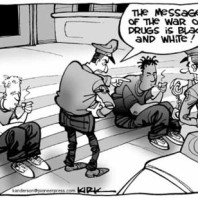
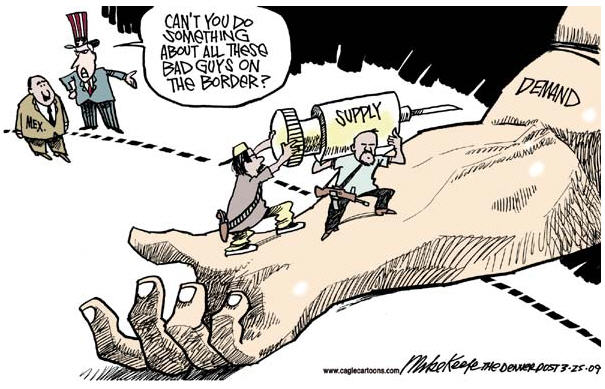
The early seventies proclaimed drug abuse public enemy number one. Giving birth to the War on Drugs and thus enhancing law enforcement and judicial practices. It has cost one trillion dollars after millions of arrest and has resulted in no changes to illegal drug use. Instead we have 500,000 people incarcerated for nonviolent drug crimes.  This call for action against drugs have resulted in hyperactive policing of poor persons and minorities even though drug usage is similar across the board and  federal studies show more drug use among white youths. Disproportionate arrests that have created horrifying circumstances where white Americans, the majority of this country use crack cocaine more than African Americans but African Americans account for 85% of crack cocaine arrests. A new focus point since the 90s being the arrest of easily targeted poor whites for use of methamphetamine. Not a war on drugs but a war on poverty as displayed by glorified drug arrests.

Early 2000s we have “Pot Princess” Julia Diaco from New York who after multiple drug sales to an undercover narcotics officer facing up to 25 years in prison was sentenced to 5 years on probation. An injustice heightened in this article http://www.drugpolicy.org/news/2006/03/nyu-pot-princess-sentenced-treatment-and-probation-despite-multiple-drug-sales at the comparison of Ashley O’Donoghue, a black man who was also arrested as a first time nonviolent drug offender who is serving seven to twenty one years. Now nearing the end of  2015 we have Sarah Furay an “adorable drug kingpin” of Texas http://www.thedailybeast.com/articles/2015/12/01/when-white-girls-deal-drugs-they-walk.html the daughter of a DEA agent possessing five different narcotics along with packing materials and two digital scales.

After learning about the woman from Texas, her privilege and her narcotic possessions, justice would be that she would get served the life ending consequences that come to racial minorities and those living in poverty. But her arrest does little to the fact that the war on drugs has created a target of brown and black bodies and those who live in poor neighborhoods as the worst and ONLY enemy. These stereotypes have created hyper action to one that grant invisibility to another. So long as we keep drug users and dealers in our minds to a certain stereotype we keep the Sarah Furays of this country profitable in their markets and safe from incarceration and public scrutiny. If this policy were really about protecting our children by confiscating drugs that can hurt them, there would be a lot more drug raids on and around college campuses. Furthermore if the war on drugs is truly about keeping people safe which can be interpreted as keeping people healthy we should address the root of why people are seeking narcotics.
 

illegal-drug-demand


References

Giordani, E. (2015). Criminal Justice. In Latino stats: American Hispanics by the numbers. New York, New York: The New Press.

Haglage, A. (2015, December 1). When Whtie Girls Deal Drugs, They Walk. Retrieved December 17, 2015, from http://www.thedailybeast.com/articles/2015/12/01/when-white-girls-deal-drugs-they-walk.html

Jarecki, E. (Director). (2013). The House I Live In [Motion picture on DVD]. Virgil Films.

Mohamed, A., & Fritsvold, E. (2012). Dorm room dealers: Drugs and the privileges of race and class (Paperback ed.). Boulder, Colorado: Lynne Rienner.
Newman, T. (2006, March 22). NYU “Pot Princess” Sentenced to Treatment and Probation Despite Multiple Drug Sales. Retrieved December 17, 2015, from http://www.drugpolicy.org/news/2006/03/nyu-pot-princess-sentenced-treatment-and-probation-despite-multiple-drug-sales

“Supply Demand” Graphic. Mike Keefe. (2009).The Denver Post. www.eaglecartoons.com http://www.ldjackson.net/wp-content/uploads/2011/02/illegal-drug-demand.jpg

“War on Drugs Message” Graphic. Kirk. Kanderson@pioneerpress.com http://greenwellness.org/wp-content/uploads/war_on_drugs_is_bw_kirk_anderson_20.jpg


Islamophobia: The Stereotyping and Prejudice Towards Muslims Since 9/11

The United States has a long history of discrimination and prejudice that has led to a lot of struggles and negativity for a lot of groups. Currently, our nation holds discriminatory attitudes and practices towards many minority communities. A lot of this can derive from ethnic, religious, racial, and gender prejudices that set our nation back. Ever since the horrific events of September 11, 2001 (the day our nation was under attack), the Muslim community has been under strict scrutiny when it came to people’s fears and paranoia. After the terrorist attacks, Muslims across the nation were immediately looked down upon and many even saw themselves being watched by the American government. During this time (War on Terror), America was essentially seeing a rise in Islamophobia (dislike/prejudice against Islam/Muslims) that would eventually hurt community relations, and scrutinize innocent Muslim Americans. Now with the continued War on Terror (fight with ISIS), America sees itself heading in the same direction with negative Islamic attitudes, as well as outrageous political bans. In order for terrorism to cease and Islamophobia to end America (the government and the rest of non-Muslim society) has to be in more effective community relations with Muslim communities to ensure prosperity, security, and freedom for all is obtainable.

After the 9/11 attacks, many blamed the whole religion of Islam for preaching destruction and violence, without even considering that these hijackers (terrorists) were extreme radicals. In the Times article, “The True, Peaceful Face of Islam,” author Karen Armstrong explains that the the very word Islam is related to a longing for peace (Armstrong, 2011). When the Prophet Muhammad brought the inspired scripture known as the Koran to the Arabs in the early 7th century A.D., a major part of his mission was devoted precisely to bringing an end to the kind of mass slaughter we witnessed in the 9/11 attacks (Armstrong, 2011). However, American society does not tend to see this peaceful side of Islam, but rather mostly sees the skewed version of it from radicals. There are those in American society who see a correlation between terrorism and Islam, yet they fail to understand the idea that there are people who misinterpret scripture and take it to the extreme. Some of these extreme radicals who skew the religion of Islam (to tailor their need to kill innocent in order to get their point across) are considered fundamentalists. Fundamentalists of any religion are the one’s who take the idea of warfare and self-defense to the extreme (making them radical) without even considering a peaceful option (such as Islam proclaims). As Armstrong notes, it would be as grave a mistake to see Osama bin Laden as an authentic representative of Islam (Armstrong, 2011). From already knowing that the many American citizens see Osama Bin Laden (mastermind of 9/11) as a representation of Islam is disturbing, and is the kind of mindset that leads to prejudice, discrimination, and scapegoating of millions of Muslims who wish to cause no harm.

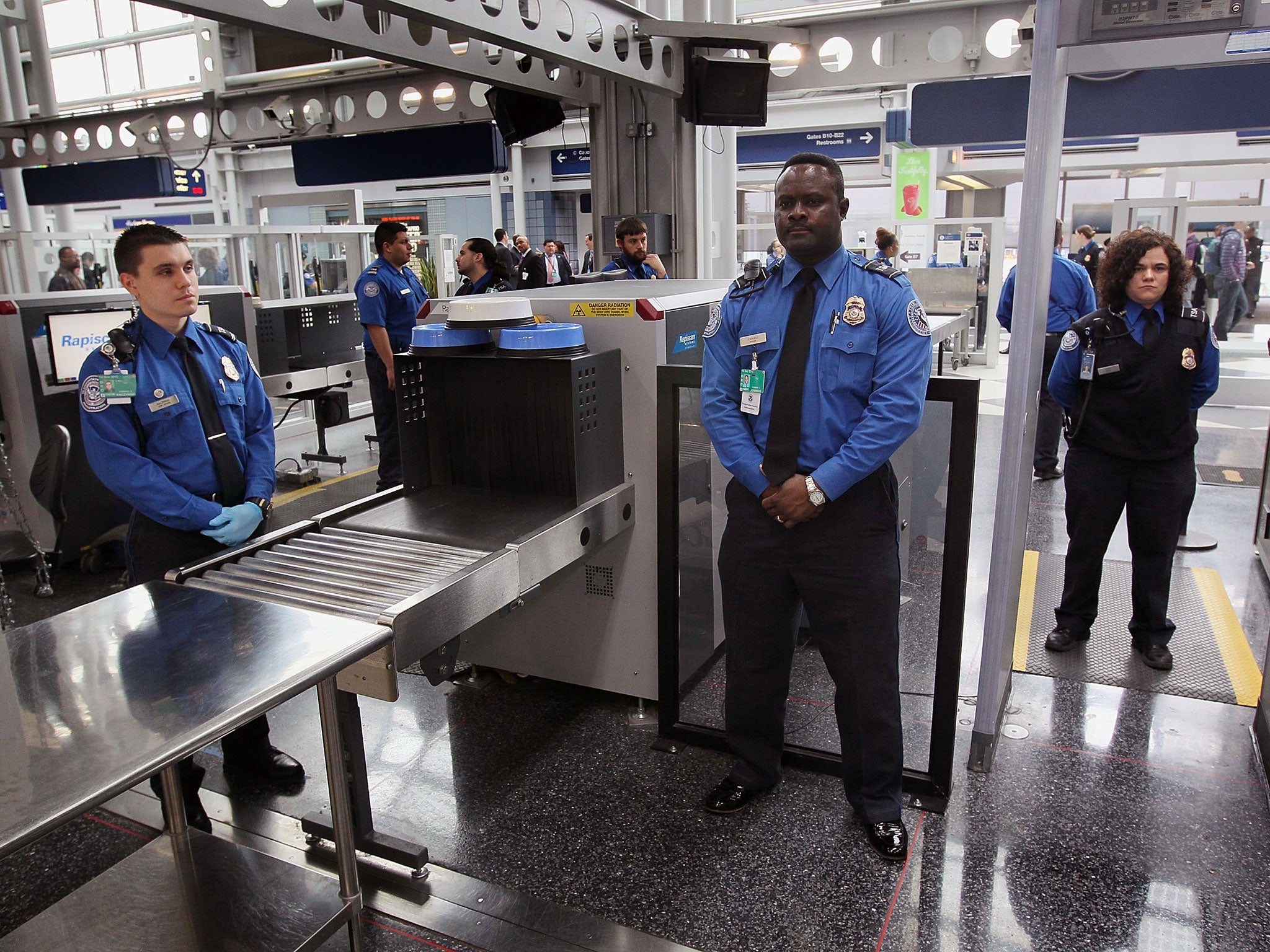
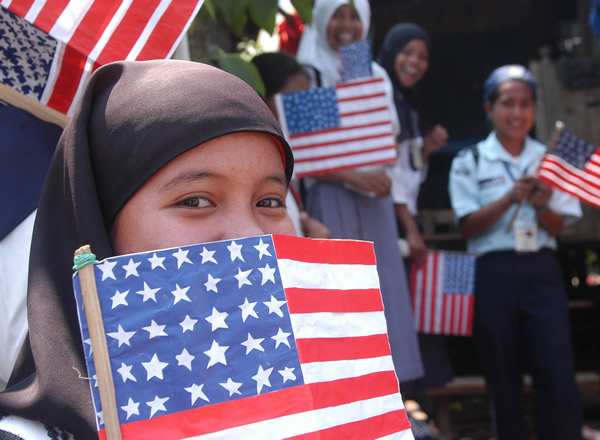
The religion of Islam is often unfairly presented as hateful and violent, which leads to a lot of prejudice and hatred towards Muslims in America. Currently, Americans are tending towards less favorable views of Islam which has led to a lot of negativity in U.S. communities (Zaal, 2015). According to the Council on American Islamic Relations, civil rights violations targeting Muslims in the workplace, at religious institutions, and in schools have escalated (Zaal, 2015). Sadly, many Muslims have overall been looked down upon, and have often been seen as second class citizens. The media is also a big factor in spreading Islamophobia, that includes spreading fear across the nation. Hundreds of images (media) portray Arabs as violent and barbaric (Zaal, 2012). These inaccurate depictions sometimes lead to people taking part in hate crimes against Muslims. Hate crimes against Arab and Muslim Americans have even increased dramatically in the months and years following September 11, 2001 (Cavendish, Disha, King, 2011). Many of these anti-Islamic attitudes showcases people acting in physical and psychological harm, with many Muslims often in fear for their lives. The threats of burning copies of the Koran on the anniversary of 9/11 suggest that stereotypes portraying Arabs and Muslims shows that’s negative attitudes towards Muslims is still consistent in American society (Cavendish, etc, 2011). In the eyes of many non-Arabs, a relatively large concentration of Arabs or Muslims may trigger fears of terrorism or mass violence (Cavendish, etc, 2011). Gallup polls have even indicated that almost a quarter of Americans singled out Arabs as being suspicious (Cavendish, etc, 2011). This suspicion that a lot of Americans have would mean that many would want Muslim (Middle-Eastern) people to be consistently watched and checked, as if they can never be trusted. 58 percent of Americans favored a requirement that Arabs have a special and more intensive screening process at airports (Cavendish, etc, 2011). This would mean that Homeland Security officials (TSA) could have Muslim people step aside, which increases racial profiling and prejudice. The animosity towards Muslim people is a huge problem that creates divides in our society and often discriminates (and persecutes) people, which leads to frustration on both sides.

Currently, different political leaders are pushing stereotypes forward. Right now we see some political (presidential) candidates who want to create more barriers for Muslims in our country and around the world. When these negative labels and stereotypes are compared to the actual radicals (of any religion or background) who wish to cause harm and destruction, those radicals can actually use the stereotypes to their advantage. When looking at Trumps ban on Muslims entering the U.S., it’s not only morally wrong to prevent a certain group from coming in, but it can also backfire on our nation. While Trump assumes that stopping Muslims from entering the U.S. would boost domestic security, experts say such rhetoric bolsters the message of extremist groups like ISIS, and ultimately increases animosity and potential retribution attacks against the U.S. (Salhani, 2015). If we ban a specific group of people, its very likely that we will see negativity and retaliation brought onto the United States. Even though Trumps plan only calls for banning Muslims who are currently trying to come into the U.S, it still will lead to a harsh divide (lot of problems) since many of them are political refugees trying to find safety amidst chaos. If a country (America) denies them (based on fear that terrorists will hide within the refugee population), refugees would likely have to turn back and be in the midst of danger; which might lead to being brainwashed to join the terrorists cause. ISIS often gains support by convincing vulnerable youths prone to ideological radicalization that the west is against Islam and the Muslim way of life (Salhani, 2015). Statements like Trump’s latest only reinforce that perception and potentially influences people who are susceptible to ISIS propaganda (Salhani, 2015). By creating these divides with Muslims in our community and around the world, we ultimately make social barriers which might point these people to going in the direction of radicalism.

Discrimination and prejudice is all too common to the United States. Many people of different backgrounds have seen various types of discrimination that have led to a lack of trust and truly understanding one’s culture/background. All American citizens need to realize that our nation is one big melting pot (all sorts of backgrounds coming together) and that there’s no room for stereotyping and prejudice. In some ways, when we hear of a terrorist attack, we automatically think of Islamic people who hold the ideology of seeing America being in ruins (destroyed). However, American society doesn’t realize that these radicals (extremists) can come from any background or religion. As non-Muslim American citizens approach this serious topic of terrorism, they often find themselves fuming in negativity towards Muslim communities. This type of hatred only slows down the process of integration for millions of Muslims who are innocent and believe in American values. Scapegoating Muslims also feeds into the negativity that terrorists groups (like ISIS) preach, which could ultimately make them stronger if Islamophobia persists. Its up to our nation to create more community alliances with Muslims in the U.S. and abroad so that they can feel less persecuted against. America is the land which should symbolize safety and security for anyone, no matter what background he or she comes from.
References

Armstrong, K. (2001, September 23). The True, Peaceful Face of Islam. TIME.

Disha, I., Cavendish, J. C., & King, R. D.. (2011). Historical Events and Spaces of   Hate: Hate Crimes against Arabs and Muslims in Post-9/11 America. Social           Problems, 58(1), 21–46.

Salhani, J. (2015, December 8). Trump’s Muslim Ban Is Exactly What ISIS Wants. Think Progress

Zaal, M. (2012). Islamophobia in Classrooms, Media, and Politics. Journal of     Adolescent and Adult Literacy, 55(6), 555-558.

http://www.telequran.com/quran-learning-blog/wp content/uploads/2012/03/muslim-prayer-1.jpg

http://images.elephantjournal.com/wp-content/uploads/2010/08/Picture-125.png

http://www.onyxtruth.com/wp-content/uploads/2015/09/Islamophobia-Onyx-Truth.jpg

http://www.lastmiracle.com/wp-content/uploads/2013/05/islam_america.jpg

http://media.namx.org/images/editorial/2014/09/0902/n_dado_isis/n_dado_isis_500x279.jpg

http://s.ngm.com/2015/03/syrian-refugees/img/syrian-refugees-opener-615.jpg

http://i2.cdn.turner.com/cnnnext/dam/assets/120831080458-tsa-security-story-top.jpg

Tolerance & Censorship on College Campuses

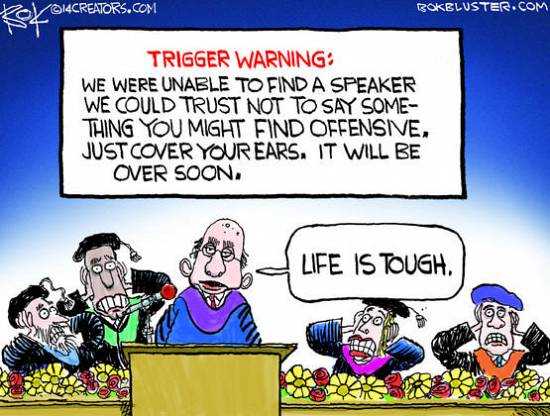
trigger-warning


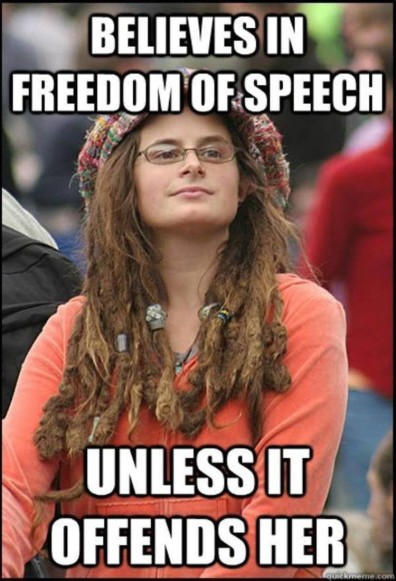
First, I would like to make it very clear that I believe every student should feel safe in their academic environment. I do not intend to discredit the various movements for inclusiveness happening at colleges across the country, or discount the oppression that any student currently feels or has felt in the past. I do not claim to be in any position to say how someone has or has not been affected by attacks on their identity, no matter how subtle, perpetuated by the culture of college campuses, their peers, or society as a whole. That being said, I think that encouraging tolerance on college campuses can in fact cross the line and infringe on peoples first amendment rights. Studies done over the past six decades have repeatedly shown that people are more likely to support free speech when described in abstract terms, but when given specific scenarios, their support for free speech decreases. The problem with that is that the first amendment should be applied in all scenarios in which the speech is protected.

At Wesleyan University, a known liberal campus, students were outraged at an opinion piece published in the school newspaper that criticized some of the tactics, related to the Black Lives Matter movement. The article did not comment on the motivations of the movement. The paper issued an apology after so many people were upset and pledged to provide a “safe space for students of color on campus” but students started a petition and the entire newspaper was ultimately shut down. At Amherst college, students made a list of demands for the school administrators that included punishing students who expressed dissenting opinions- for example, holding signs that said “all lives matter” and that the schools honor code be rewritten to include a zero-tolerance policy for racial insensitivities. If there is anything I’ve learned as a criminal justice student, its that zero tolerance policies can do more harm than good. At a University in California the board of Regents considered implementing a “tolerance policy”. The idea is that students should be “free from acts and expressions of intolerance” while yes, that would be great-universities should not control what their students and faculty say. Nobody should be afraid to speak their mind or express their opinions. Students should not be guaranteed the right to not be offended.

I think these examples illustrate when the demand for tolerance becomes a demand for censorship. Implementing speech codes or tolerance policies, are not the answer. The American Civil Liberties Union, or ACLU, has long protected the rights of free speech, even in defense of bigotry, racism, sexism and homophobia because “free speech rights are indivisible…the same laws or regulations used to silence bigots can be used to silence you”. The ACLU has also spoken specifically against the use of free speech codes on college campuses stating that they “have proven ineffective at best and counter-productive at worst”. Historically, speech codes have even been used against the people they are intended to protect. imageedit_2144_6694143902

My argument is not against the substance of the protests or the beliefs behind the demands of speech codes and tolerance policies. Nor is my intent to tell people how they should or should not express their beliefs or feelings or further oppress those who are actively speaking out against such oppression. But, in the interest of social change, which I do believe to be the ultimate goal of such protests, there needs to be open debate. As Connor Freidendorf, writer for The Atlantic articulates:

how can one fully understand student activists without attentively listening and then engaging in conversation and, where there is disagreement or lack of clarity, debate? Without a culture of free speech there cannot be constructive dialogue.

This is by no means implying that the burden to engage in debate or encourage public discourse should be put solely on the groups who are protesting. Instead, I believe this is where university administrators should step in. That being said, I do not believe any argument is well-served by attempts to punish or completely block dissenting viewpoints.

I agree with the Supreme Courts’ sentiment that “the proudest boast of our free speech jurisprudence is that we protect the freedom to express ‘the thought that we hate’”. Students of all backgrounds, beliefs, identities and viewpoints should have the freedom to speak their mind and engage in healthy debate and critical thought without facing censorship or oppression. Not only is this the nature of higher learning but it is the more effective method for ensuring long term social change. As supported by cultural cognition, misperceptions of facts surrounding free speech are normal to human cognition
but they should not drive policy. Universities can foster an environment of respect and tolerance by raising awareness, promoting dialogue and speaking against discrimination and bigotry without taking away anyone’s rights. Finally, securing and supporting the right to free speech by speaking against the implementation of speech codes or tolerance policies does not inhibit the discourse on inclusion or marginalization but instead vital too it; “speech codes don’t really serve the interests of persecuted groups. The First Amendment does”.


https://www.washingtonpost.com/news/volokh-%20conspiracy/wp/2015/09/11/university-of-california-considering-recognizing-%20a-%20right-to-be-free-from-expressions-of-intolerance/

http://www.theatlantic.com/politics/archive/2015/12/what-student-activists-can-learn-from-bygone-free-speech-fights/419178/

http://www.theatlantic.com/politics/archive/2015/10/the-anti-free-speech-movement-at-ucla/410638/

http://www.theatlantic.com/politics/archive/2015/11/how-campus-activists-are-weaponizing-the-safe-space/415080/#article-comments

http://www.theatlantic.com/politics/archive/2015/11/the-new-intolerance-of-student-activism-at-yale/414810/

https://www.aclu.org/hate-speech-campus

Oscar Pistorius: Perceptions of Disability and Masculinity

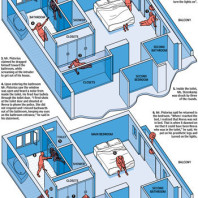
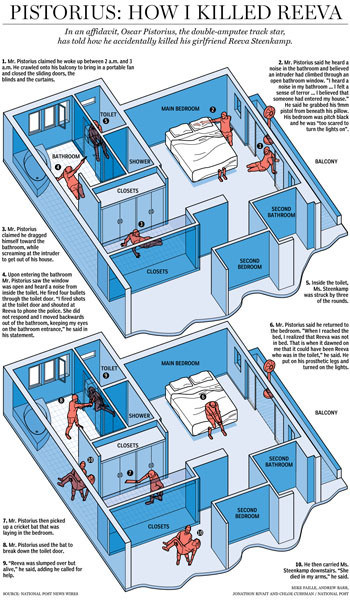
Now that you all already know the main facts of the Oscar Pistorius’ case — that he fatally shot his girlfriend, Reeva Steenkamp, on February 14, 2013, in the bathroom of his estate in Pretoria, South Africa – and especially now that the sentence has changed, I thought that I would delve deeper into Oscar Pistorius’ intent on murdering his girlfriend, Reeva Steenkamp. I think that we can all agree that Oscar Pistorius shot through the bathroom of his estate four times and that his girlfriend ended up dead because of it; however, there has been some controversy over whether the homicide was pre-meditated, with him knowing full well that his girlfriend was in the bathroom, or if it was accidental, with him thinking that an intruder was in the house, just chilling out in the bathroom with the door shut. It is completely possible that an intruder could have been in the house that night, given the high crime rate, especially in gated communities. The following image states the order of events that happened the night of the shooting.

Source: National Post, http://www.michelleniniblog.com/wp-content/uploads/2013/05/reeva-steenkamp-4.jpg

From here on out, I am going to assume that his testimony of what happened that night was completely truthful. However, regardless of whether he thought that he was shooting an intruder or if he thought that he was shooting Reeva Steenkamp, his intentions were the same. There was no way that he could shoot a person four times through a small bathroom with nowhere to go and not kill them. However, the act of grabbing a gun when he heard sounds coming from the bathroom was likely the result of the fact that he was disabled and was more likely to experience fear and feel that his life was being threatened.

Q: Is the fact that Oscar Pistorius is disabled an excuse for him to kill his girlfriend? Are there any excuses for him for shooting Reeva Steenkamp?

No, even though disabled people feel more threatened than able-bodied individuals due to the fact that when they are in high-stress situations, they are less mobile and less likely to get out of the situation, just because he does not have the bottom half of his legs is no excuse to committing murder. He still has two working eyes and he could see if his girlfriend was in bed with him before shooting up a bathroom door.

It is also believed that Pistorius’ disability led him to feel emasculated, because disability is often considered feminine. He used women, sports, and guns to develop his masculinity. He was involved in relationships with attractive blonde women to satisfy any inadequacies in his life. He probably engaged in younger, thin, blonde women thinking that they would be insecure and that he could diminish his insecurities by controlling them and being the “man” in the relationship.

The Most Important Question: Did the emasculation from his disability cause Oscar Pistorius to shoot Reeva Steenkamp?

Q: If you were in the same situation as Oscar Pistorius, would you do the same thing that he did? Why or why not?

Personally, I would not have done what he did. First, I would have looked to see if my significant other was still in bed and then when I saw that she was not in bed, I would have just assumed that it was her in the bathroom and gone back to sleep.


References:

Abrahams, N., Jewkes, R., & Matthews, S. (2010). Guns and Gender-Based Violence in South Africa. South African Medical Journal, 100 (9), 586-588. Retrieved from http://www.samj.org.za/index.php/samj/index

Breetzke, G. D., & Cohn, E. G. (2013). Burglary in Gated Communities: An Empirical Analysis Using Routine Activities Theory. International Criminal Justice Review, 23 (1), 56-74. DOI: 10.1177/1057567713476887

Cherney, J. L., & Lindemann, K. (2014). Queering Street: Homosociality, Masculinity, and Disability in Friday Night Lights. Western Journal of Communication, 78 (1), 1-21. DOI: 10.1080/10570314.2013.792388

Hickey-Moody, A. (2015). Carbon Fibre Masculinity: Disability and Surfaces of Homosociality. Journal of the Theoretical Humanities, 20 (1), 1-17. http://dx.doi.org/10.1080/0969725X.2015.000000

Onishi, N. (2015, December 3). Oscar Pistorius Guilty in Murder of Reeva Steenkamp, Appeals Court Rules. The New York Times. Retrieved from http://www.nytimes.com/2015/12/04/world/africa/oscar-pistorius.html?_r=0

(2014). Oscar Pistorius Trial: Evidence. BBC News. Retrieved from http://www.bbc.com/news/world-africa-26417240

What they don’t want you to know about Immigration (Final Post)

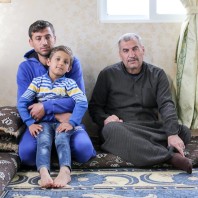
Way back when I did my first blog post on the Syrian Refugee Crisis. Regrettably it’s only gotten worse since then. So I’ve decided to take a look at the actual economic and security effects of immigration, not what you hear in the media, through the lens of all our discussions and my own research. Casey’s final post goes into much more detail about security, so check that out too! I also follow a Facebook page, called Humans of New York. They recently interviewed groups of refugees who have been approved to travel to the United States. (One of which is the family shown in the cover photo) I strongly encourage everyone to read about their journey.

So, what is the media saying? If you’ve watched the news in the past week you know there is a very real concern that some of these migrants are Islamic State members. You also know that people coming over are just more competition for the same scarce jobs. We’ve heard this rhetoric before though, with Irish immigration, Mexican Immigration, and every other time people have come to live in the United States. We can peel back these layers and take a look at what actually happens.

First, some information about the economy. The United States is a postindustrial advanced democracy, which pretty much just means most of our jobs are in the service sector and we have some form of redistribution going on. The redistribution is the key part. In the United States the most known redistribution program is medicare. Well, we have a looming crisis on the horizon. Not enough money is going into the program through taxing the working population to provide the level of support we want for the non-working population. Just from the previous sentence, two solutions emerge. We can raise taxes, cut benefits, or both. Both actions have their pros and cons. The thing is, we have a scientifically proven third option to add more money to these programs without raising taxes or cutting benefits. You guessed it, immigration. Adding more people to the workforce raises the amount of taxes being collected without actually raising taxes. Some countries have caught onto this. (Ever wonder why Germany takes the most Syrian refugees compared to any other country?) Germany also happens to be in the middle of this redistribution crisis.

So, why aren’t we accepting immigrants to help our economy in the long run? Well, that’s where the security issue comes into play. If history has shown one thing, it’s that our nation of immigrants hates immigrants. The potential for Islamic State militants to be among the crown isn’t helping matters at all. Thankfully, research has been done on this as well. Turns out, immigrants just want a safe place to live, work, have children. Most violence around immigrants is actually directed at the immigrants themselves from citizens of the host country. Just check the number of property crimes against mosques if you don’t believe me. The truth is, the vetting process is so intensive and so incredibly selective that any militants could smuggle themselves into the country much faster then the time it takes to get a state department interview scheduled. (Which, in case you’re wondering, takes a long time).

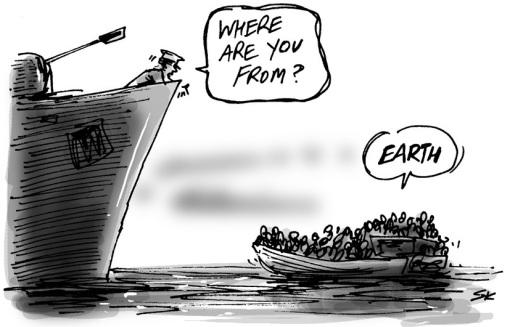
In the end, economic and security issues seem secondary to preserving and helping other people. But if people really need evidence to justify helping, we can provide that. I’ll leave you with the picture I used in my first blog post which, in my opinion, really drives to the heart of the issue.

Earth


References

Rudolph, Christopher (2003). Security and the Political Economy of International Migration. American Political Science Review, 97(4) 603-620

Razin, A., Sadka, E., Swagel, P. (1998). Tax Burden and Migration: A Political Economy Theory and Evidence. National Bureau of Economic Research, 6734

Fitzgerald, J., Leblang, D., Teets, J. (2014). Defying the Law of Gravity: The Political Economy of International Migration. World Politics, 66(03) 406-465

Lekies, K., Cascante, D., Schewe, R., Winkler, R. (2015) Amenity Migration in the New Global Economy. Society and Natural Resources, 28(10) 1114-1151

Photo: http://i100.independent.co.uk/article/the-cartoon-that-sums-up-the-worlds-migrant-crisis–g12atJpSWZ

Featured Image: Humans of New York

Racial Disparity in the Criminal Justice system.


Unknown-1As a person of color, a women of color at that, this hits home for me. I am not a person to talk about my experiences a lot of the time, but I feel as though this is an appropriate time to do so. Racial Disparity, “the proportion of a racial or ethnic group within the control of the system is greater than the proportion of such groups in the general population (Sentencing Project).” Is a big problem that I myself, and many others face on a day to day basis. When we look at color and position in society, white men are at the top, then Black men, then White women, and then lastly Black Women. Black people, or minorities for that matter are not valued like those of our peers.

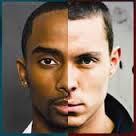
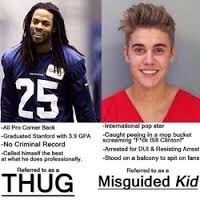
images-1We can see examples of this with police officers and racial bias and profiling. The picture on the left of Justin Bieber and Richard Sherman is a good example of this. As a society we are so quick to think that an African American is a “Thug”, uneducated, not a law abiding citizen hampered to his white counter parts. in this photo we can clearly see that is not the case. This is not a rare picture either, this is a reality. Because of the disproportionate representation of African Americans, especially African American males incarcerated it makes it hard to believe that there are quote on quote “good” African Americans out there. I myself as well as many of my uncles have been racially profiled. It infuriates me more than anything else.

In the video right below this, she talks about many of the disparities that we can see in the criminal justice system. many being that of the crack cocaine and powder cocaine disparity, as well as the incarceration disparity, and jury selection bias. She goes on to tell explain more of the disparities that many African Americans face on a daily basis. We can also see this with traffic violation bias. A police officer might pull someone over for a minor traffic violation but then go on to abuse his power and search the car for weapons or drugs because of the color of the person they pulled overs skin.

What the women in this video is talking about like i said is the truth for many African Americans in this country today. It breaks my heart that many of my brothers and sisters are pressed and have a harder time living in a society that doesn’t even want them here in the first place.


Questions:

1. Should/would cultural competency trainings be of help to law enforcement including those of lawyers, judges, etc. when dealing with minorities in the criminal justice system?

2. If the Crack Cocaine vs. Powder Cocaine disparity dropped, how would we get racial disparity to not be a problem in this country at the level it is today?

3. What systematic change would it take for minorities to not be presses, as well as face a disparity when in the criminal justice system?

References: 

http://www.sentencingproject.org/template/index.cfm

http://nilevalleypeoples.blogspot.com/2015/08/how-obama-plays-upon-white-guilt-hilary.html

Why the Deaths of Black Men and Boys Are Not Accounted For

As an African-American woman, who supports Black feminism, this topic is out of my usual comfort zone to talk about but it is an issue that needs to be brought to light. Black men and boys are now considered prey to our society, yet no one is doing anything about it.  There has been no in depth research or analysis on WHY this is happening, and the only answer that is given in response to their deaths is racism.  Well that answer does not suffice.  If it is racism, then why are Black males the ones being victimized the most?  And even if racism is the answer, there is nothing being done about it because America does not call it racism.  America justifies these deaths by saying that Blacks deserve death for the danger they pose to society and the phobia that has been created in the white imagination.

Black males fill the bottom of every measure of the American population’s prosperity and health, and even though this is the case, because they are men, they are seen as having gender-based benefits. The fear of researchers and scholars in studying the misfortunes of Black males in society is rooted from the “danger” that it might reinforce gender based hierarchy and empowering men poses potential “dangers.”  Let me translate this into simpler terms:  White America will do anything to maintain its superiority over African Americans, and empowering Black men poses a threat to their domineering position.  Because there is such a division between those who are considered to be “more oppressed” it prevents the ability to do a serious study of the relationship between the historical and political causes of the violence against Black males.  Not addressing the deeper causes for the death of so many Black men means that we are also failing to address America’s seemingly endless killings of Black males.  This is something that should not be able to be so easily concentrated to acts of racism.

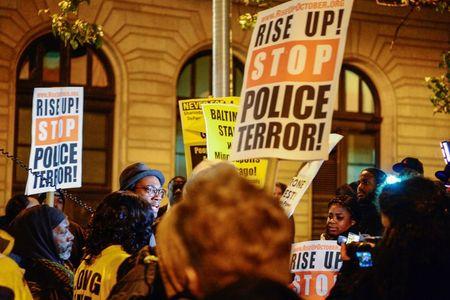
Protestors gather outside of the courthouse in Baltimore, Maryland November 30, 2015, on the first day of jury selection for Baltimore Police Officer William Porter who is  charged in connection with the death of Freddie Gray.    REUTERS/Bryan Woolston
Protestors gather outside of the courthouse in Baltimore, Maryland November 30, 2015, on the first day of jury selection for Baltimore Police Officer William Porter who is charged in connection with the death of Freddie Gray. REUTERS/Bryan Woolston

While Black men and boys continue dying because of state and white vigilantes, scholars are “highly encouraged” to refrain from theoretically accounting for these deaths through any sort of philosophical study. Why might you ask? Well, allow me to assist you in your thoughts… There is mass resistance from our universities and our scholars to consider Black male vulnerability beyond feminism or other stereotypes that link Black males to being culturally unstable and inherently violent.  Any study of Black male vulnerability is targeted as an act to erase Black female suffering.  THAT IS NOT THE CASE!  In studying Black male vulnerability, we are not erasing Black female suffering or anyone’s suffering.  If anything, this movement to understand why Black males are being murdered would help strengthen the foundations of Black feminist organizations or movements like #BlackLivesMatter.  Black males are disproportionately affected by violence, incarceration, poverty, unemployment, and suicide in America, yet we insist that the deaths of these Black men do not need to be accounted for.  It is this silence that ultimately takes advantage of the deaths that cause Black men to be underrepresented in our society.


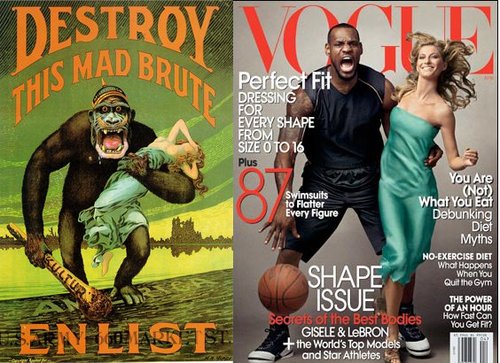
Is the “negrophobia” that pushed white America to support lynchings as a form of murder is the same fear and anxiety that allows the white public to endorse the murder of Black men and boys as “justifiable homicides”? Police officers justify the killings of Black males by claiming that they were in “fear of their lives.”  America has created a system that justifies police violence, mass incarceration, and exclusion.  The concepts about Black masculinity is used to justify the murder of Black males in society and complicate the full picture of Black male oppression in America.  But where did this stigma or phobia come from and how did it obtain so much power? Well, often times, society imagine the Black boy, a child, to be physically threatening, and this idea is manifested through savagery inherent to Black stereotypes.  Black males have also been associated with animals (monkeys and apes) which diminishes any form of sympathy that was left for their humanity.  As a result of these characterizations, there is more acceptance of higher levels of violence directed towards them.

lebron-vogue-cover

Ultimately, there is a clear connection between the deaths of Black males in society and the erasure of Black men from the realm of theory. The current theories in place that associate the death of Black males to the broad description of racism is a claim that in neither thoroughly research or analyzed.  Because of this, there is an inability to depict the particular kind of oppression and violence that defines Black male existence.  It is as if society classifies the deaths of Black males as being racist acts of violence and then finds ways to justify those acts and then move onto the next case.  Michael Brown was a victim and example of the power a white life has over Black male existence and is a clear demonstration of the seemingly abundant power of white individuals’ ability to enforce the anti-Black agreement against these particular Black males.  Black male death represents the fact that racism is the power whites have over the world which results in the insignificance of Black lives.  Black men are thought to simulate white patriarchy which is something that is unattainable because of Black male disadvantage, but one that is affirmed through society’s certainty in the decision that his death is the only way to fix the dangers he poses to society.  But these deaths honor the unfinished, perhaps unending, struggle to assert black humanity in a country built on its denial.


References


Butler, P. (2013). Black Male Exceptionalism: The Problems and Potential of Black Male Focused Interventions . Dubois Review.

Goff, P. (2008). Not Yet Human: implicit knowledge, Historical dehumanization, adn contemporary consequences. journal of personality and social psychology, 292-306.

Goff, P. (2014). The essence of innocence: consequences of dehumanizing black children. journal of personality and social psychology, 526-545, 540.

Hutchinson, D. (2010). Identity Crisis:Intersectionality, Multidimensionality, and the Development of an Adequate Theory of Subordination. Michigan Journal of Race and Law.

McDaniel, A. (2011). The Black Gender Gap in Educational Attainment: Historical Trends and Racial Comparisons. Demography.

Wynter, S. (2006). Interview in Proudflesh. Proudflesh: New Afrikan Journal of Culture, Politics & Consciousness.


Women’s Rights and Selective Patriarchy

We no longer live in the crude days of centuries past. This is a new modern era and as such society should change to reflect our positive change in the world. I am talking about Women’s rights and how it clashes with the idea of patriarchy. Is there a place for patriarchy in america? Can it exist alongside Equal rights for women? I say in a way, yes.

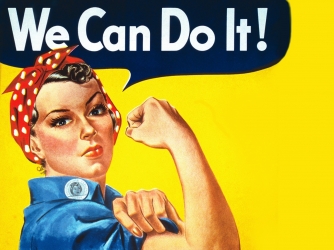
All men, women, and children are created equal is what we like to tell each other at all points in our lives. While this may be true, not all jobs are created equal. The jobs in question are any and all manner of manual labor that involves cohesiveness and fluid teamwork. For instance lets have a look at the military. As recently as this year, the army is allowing women to train for combat roles. This is new as before women were restricted from fighting. While some may claim this is a win for women’s rights… it isn’t. Now let me tell you why you Rosie the Riveters out there.We-Can-Do-It-Rosie-the-Riveter-Wallpaper-2-AB

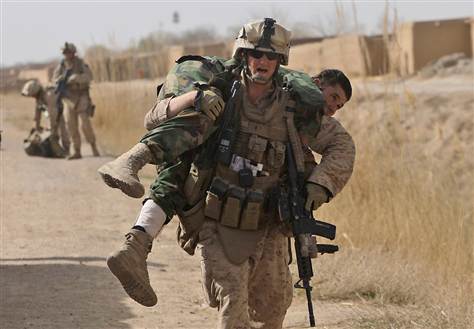
While the army was playing with the idea of female soldiers, which is still currently in trials, the Marine Corps ran a similar test. However the Marines would appear to be more thorough in their needs for a soldier. Their findings were that women were not able to reliably handle the normal gear for duty, women added a different aspect to the war fighting unit that destabilizes and causes combat ineffectiveness, and lastly along with the strength disparity, women aren’t able to carry a battle buddy out from the battlefield in times of need.100220-afghan-hmed-12p.grid-6x2

There are zero problems with the women in this test group, they were all fit and were attempting the same courses as the males. In the end its just not the right place for women to be. And that is NOT a bad thing. Women are equally valuable alongside men in many different professions, specially in non combat roles. Now how about patriarchy, how does this tie you ask? Well by keeping women out of certain male roles, greater efficiency can be achieved. Roles such as a leader of combat troops or a construction manager. Both of these roles require experience and labor to achieve. If women were to achieve there jobs then there would be a lack of a bond between worker and superior. By keeping men in charge of labor intensive fields as well as combat roles, our workforce will work far more efficiently.

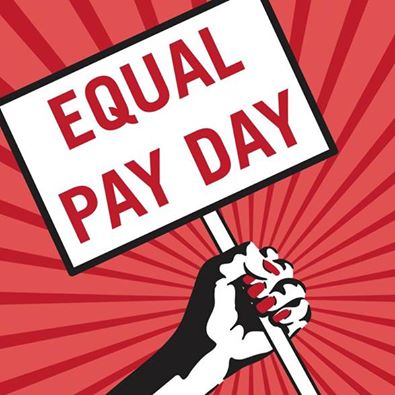
I like to call this concept “Selective Patriarchy”. By allowing men to remain in power in certain roles, we benefit as a whole. But only for these professions. Women on average make 78 cents for every dollar a male makes and that is truly an issue worth fighting for. Certain ons may not be for women, but all jobs deserve to pay equally no matter what  gender you are.


1435796939300

Women deserve the right to pursue any and all professions they desire. However at the same time, a respect for what duties men also fulfill is warranted. Some times it is acceptable to allow a strong male presence to lead over a female. In other professions and environments this is entirely unacceptable. By understanding the balance between the genders, i firmly believe we can achieve a more fluid and happy society.

-Aaron Wagner

Works cited

Bordo, S. (2003). Unbearable weight: Feminism, Western culture, and the body.

Univ of California Press.

Clinton, H. R. (2004). Living history. Simon and Schuster. Book.

Gruhl, J., Spohn, C., & Welch, S. (1981). Women as policymakers: The case of

trial judges. American Journal of Political Science, 308-322.

Rice, C. E. (2015). Women in the Infantry: Understanding Issues of Physical Strength,      Economics, and Small-Unit Cohesion. Military Review, 95(2), 48.

Smith, J. E., Gavrilets, S., Mulder, M. B., Hooper, P. L., El Mouden, C., Nettle, D., … & van       Vugt, M. (2015). Leadership in Mammalian Societies: Emergence, Distribution, Power,        and Payoff. Trends in ecology & evolution.

The Complexity of the Planned Parenthood Shooting

Unfortunately, mass shootings seem to be the the main headlines in the news on a regular basis recently. There is mourning and prayers sent to those who lost their lives, then we wait for the next shooting to happen and just repeat the cycle. Last month, on November 27, there was a shooting at a Planned Parenthood in Colorado Springs that killed three people. One police officer and two civilians lost their lives. This shooting surfaces a plethora of problems, due to the complexity of the intent of the shooter, Robert Dear. The recent shooting at Planned Parenthood forces us to take a closer look at abortion and women’s rights, domestic terrorism, and gun control and violence.

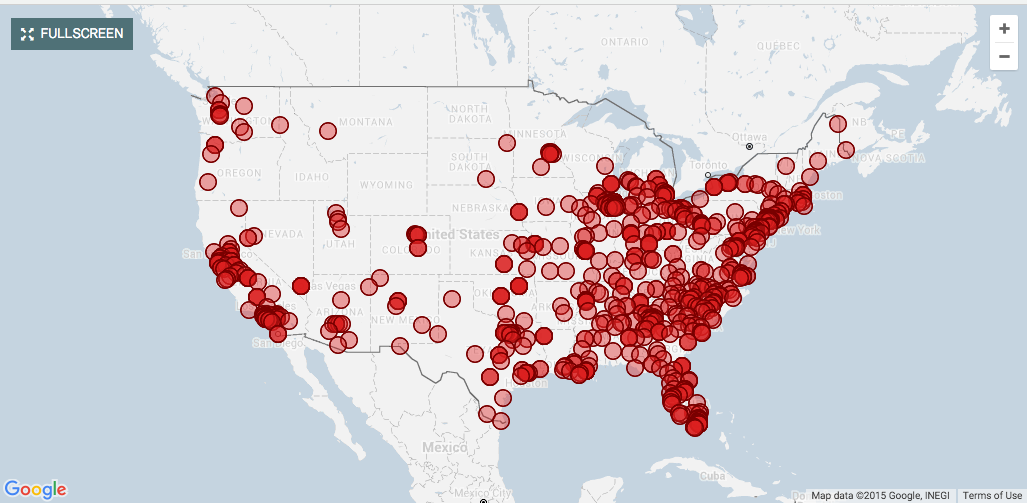
The obvious issue, gun control, is an issue that has been on the mind of many Americans lately. The map below shows the mass shootings since the Sandy Hook shooting in 2012. There is a need to protect American’s right to the Second Amendment, the right to bear arms, but there is an extremely large need to find a way to protect citizens from the overwhelming amount of gun related violence. President Obama has addressed two key focuses to this issue: to expand the background checks needed to obtain a gun and to fund research to recognize the causes of these mass shootings (Mitka, 2013). Robert Dear had a fairly extensive record, including animal abuse and charges of domestic abuse that were dropped, but was still able to be a licensed gun owner. The link between gun control and violence seems to be evident, but there needs to be steps taken to control this violence while permitting Americans to their Second Amendment rights.

Screen Shot 2015-12-16 at 12.23.19 PM

(Lopez & Oh, 2015)

While mass shootings seem to be the cause of someone who is mentally ill, Robert Dear outspokenly had political motives behind his attack. After his arrest, Dear is quoted to be saying, “Protect the babies,” a clearly anti-abortion and pro-choice expression (Vercammen & Yan, 2015). This raises the issue for many that this attack could qualify as domestic terrorism. According to the Federal Bureau of Investigation, the following is the definition of domestic terrorism:

  1. Involve acts dangerous to human life that violate federal or state law
  2. Appear intended (i) to intimidate or coerce a civilian population; (ii) to influence the policy of a government by intimidation or coercion; or (iii) to affect the conduct of a government by mass destruction, assassination, or kidnapping; and
  3. Occur primarily within the territorial jurisdiction of the U.S.
    (Definitions of Terrorism in the U.S. Code, 2013).

This attack was clearly dangerous to human life, killing three people. It was intended to intimidate the Planned Parenthood population, influence the abortion policies of the government, and affected the government by a mass killing. The attack occurred within the territorial jurisdiction of the United States. This attack seemingly falls into the definition of domestic terrorism, however officials are so hesitant to label it as such. Perhaps we are quick to label those who are not the majority in our nation, for example Muslims, as terrorists, but are fearful to label a white Christian man such as Dear as a domestic terrorist because he represents the majority population.

Below the surface of this attack, the morality of abortion and the rights to healthcare women have is brought to debate. De-funding Planned Parenthood has been a heavily debated topic in legislation today. However, de-funding clinics such as Planned Parenthood would leave women and particularly low-income minority women, disadvantaged and without access to affordable healthcare. Concerning the right for a women to choose an abortion, it could be seen as being protected under the First Amendment. Many religions, including Christianity, the predominant religion in the United States, see abortion as immoral. However, the First Amendment protects freedom of religion, meaning that religious beliefs and morals cannot be used to influence laws, such as an anti-abortion law. On top of that, women are autonomous agents, meaning that they have the right to make decisions regarding what happens to their body. These women have the same rights as anyone else to affordable healthcare, which includes access to the choice of abortion, and defunding clinics such as Planned Parenthood would disproportionately effect women, particularly minority women.

Ultimately, these mass shootings, particularly this shooting at Planned Parenthood, surfaces critical issues towards the safety and rights of Americans. Citizens should know what constitutes as domestic terrorism, and evaluate what changes we need to make in response to domestic terrorist attacks. The debate over abortion rights and the funding of Planned Parenthood will continue, but it is important to keep in mind the rights that the Constitution provides. The link between these mass shootings and gun control is apparent, and it is evident to see that there needs to be a change. These mass shootings, particularly one like the Planned Parenthood shooting that have a political motive, bring rise to all of these issues, and make it evident to see that policies need to be changed for the safety of citizens. Mass shooting front page headlines should not be a regular occurrence.


References

Lopez, G., & Oh, S. (2015). Mass shootings since Sandy Hook, in one map. Retrieved December 16, 2015, from http://www.vox.com/a/mass-shootings-sandy-hook
Mitka, M. (2013). Search for Ways to Reduce Gun Violence Spurred by Toll of Recent Shootings. JAMA, 309(8), 755-755.
Vercammen, P., & Yan, H. (2015, December 10). Planned Parenthood suspect Robert Dear has outbursts – CNN.com. Retrieved December 16, 2015, from http://edition.cnn.com/2015/12/09/us/colorado-planned-parenthood-shooting/

Final Blog Post: LGBT, and the Laws that Protect Them

As some of you may know, there are many individuals discriminated on the basis of sexual orientation or gender identity. The courts and the United States in whole have come along way to try to provide fundamental rights to the LGBT community. As seen in the Supreme Court case, Obergefell v. Hodges, ruling in a  6-4 vote to allow same sex marriage nationwide (Obergefell). What some deem a historic day for gay rights advocates as it established a new civil right.

To me, this is just scratching the surface. The 14th amendment grants all citizens born or naturalized in the United States from being denied “life, liberty, or property, without due process of the law.” The United States is founded on ideas such as freedom of speech, freedom of association, religion, liberty, equal treatment, the list goes on. And yet, the LGBT community is marginalized. Members of this group are subject to discrimination in mainstream society due to prejudices rooted in beliefs and traditions about sexuality and gender. LGBT people are suffering from various forms of socioeconomic and cultural injustices. That deprive them their rights as citizens of the United States of America. Lesbians, gay, bisexual, and transgender people are more likely to experience intolerance, discrimination, harassment and the threat of violence due to their sexual orientation.

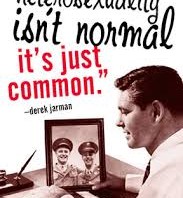
Some policy makers refuse to see that there is an actual problem, that there is in fact a need to pass laws that protect gay and transgender workers from things such as workplace discrimination. Its very much so the case of, “You dont realize what you have, until its gone,” and what they have is mainstream hetero-normative ideas the notion that nothings really wrong, they are just another social minority group wanting recognition.


Sure the Constitutions, Equal Protection Clause does not protect a citizen on the bases of sexual discrimination, but it should be implemented or addressed nationwide. LGBT rights struggles to find universal acceptance, the fact that the Universal Declaration of Human rights, drafted in 1948, does not specifically include sexual orientation allows some people to consider LGBT rights debatable (Universal). That should never be the case everyone is entitled to all the rights and freedoms set forth in the Declaration established by our founders.

The revisions to the Civil Rights Act of 1964 is a proud acknowledgement that protection is needed on the basis of sexual orientation and gender identity. As this act prohibits discrimination of the basis of race, religion, national origin, and sex in both the state and private level. However, EEOC rulings are not binding on private employers and federal courts may rule differently, but its a start non the less.

Reference:

Bendery, J. (n.d.). It Is Now Illegal For A Federal Contractor To Fire Someone For

Being LGBT. Retrieved December 13, 2015, from http://www.huffingtonpost.com/2015/04/08/lgbt-job-discrimination-federal-contractors_n_7025564.html

Calfas, J. (2015, August 1). Employment discrimination: The next frontier for LGBT  community. Retrieved December 13, 2015, from http://www.usatoday.com/story/news/nation/2015/07/31/employment-discrimination-lgbt-community-next-frontier/29635379

37 Shocking LGBT Discrimination Statistics – BrandonGaille.com. (n.d.). Retrieved December  16, 2015, from http://brandongaille.com/37-shocking-lgbt-discrimination-statistics

The Universal Declaration of Human Rights | United Nations. (n.d.). Retrieved December 16, 2015, from http://www.un.org/en/universal-declaration-human-rights/
Obergefell v. Hodges. (n.d.). Retrieved December 16, 2015, from http://www.supremecourt.gov/opinions/14pdf/14-556_3204.pdf