Skip to main content Skip to navigation

The Increasing Militarization of America’s Police Forces: Form of Oppression or a Protection for Society?

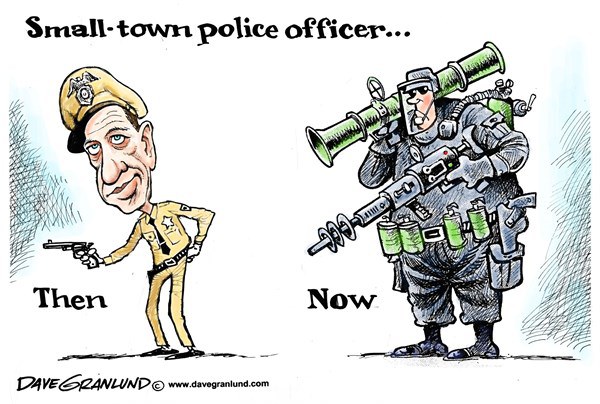
In the year 1997, two heavily armed men entered a Southern California bank and began their reign of terror. Armed with automatic weapons, body armor, and ski masks, the two individuals forced their way into the bank and created a chaotic scene in order to get their money. As Los Angeles Police Officers responded, many of them were outgunned as they didn’t have the proper resistance (weaponry) to take on the suspects at large and protect the civilians around them (Orlov, 2012). With responding patrol officers only armed with semi-automatic rifles and 12 gauge shotguns, they were for a long time losing the battle that ended in dozens of officers and civilians injured. From this day that put all of North Hollywood, California in panic mode, police departments started providing semi-automatic rifles (M-16’s) to patrol officers, as well as increasing their use of Special Weapons and Tactics Teams (SWAT) (Orlov, 2012). This sense of ramping up increases in military like models has somewhat divided the country regarding whether to militarize our nations police forces or to demilitarize them. Some argue that equipping police across the country with military graded equipment leads to a totalitarian state with too much power and control of the government/ authorities, while others argue that equipping our police force with whatever they need is essential for the safety and protection of our communities; especially faced with an ever changing threat from those who wish to cause harm to civilians. Despite the appropriate increase of militarization to the combat criminals who pose as lot of risk, paramilitary group been seen to cause a lot of harm with their aggressive tactics; often leading to frustration within the community they are meant to serve. Thus, the militarization of police should not be used immediately, but rather only be used in dire situations.

Ever since the Drug War era and the War on Terror, America’s law enforcement agencies have ramped up militaristic approaches and have led to a warrior ethos philosophy for officers. With a moral panic spreading across cities looking to put a stop to the selling and use of illicit drugs, the government stepped up its funding towards law enforcement hoping to create a deterrence. With many of these law enforcement agencies stepping up its presence in communities across the country, they created more specialized units; trained to handle the problems with strict guidelines of power and enforcement. The Drug Enforcement Agency and many other federal and local agencies put more funding and focus towards units that would rely on a forceful tactic of element and surprise to counter-act crimes (mostly dealing with drug offenses). These specialized unites (SWAT) would often force their way into homes (with body armor, assault rifles, flash-bangs, and a determined mindset to ravage these houses) of suspected drug users and dealers. More communities across the country (mostly poor minority communities) are experiencing heavily armed SWAT teams raiding people’s homes in the middle of the night, often just to search for drugs (ACLU). These police officer’s mindsets of a warrior mentality are often linked with the governments philosophy of “tough on crime.” However, for a lot of these cases the offender didn’t even present a violent offense. Last year (nationwide) police arrested 1.6 million nonviolent drug offenders (Stamper, 2011).  Some of these non-violent drug offenders were taken into custody from SWAT teams assaulting their homes. The mere fact that these people presented no danger (based on intelligence gathering) make these dramatic invasions of the home unnecessary, as well as creates a traumatic experience for the people inside. In very shocking cases of SWAT team raids gone wrong, communities see that wrong houses are hit, as well as innocent people and family pets are shot and killed by the police raiding the homes. (Stamper, 2015). Problems like these where you have non violent offenders facing up against heavily armed men breaking down their doors, along with innocent people/pets getting killed creates an image of a public-safety institution (the authorities/police) at war with it’s own people.
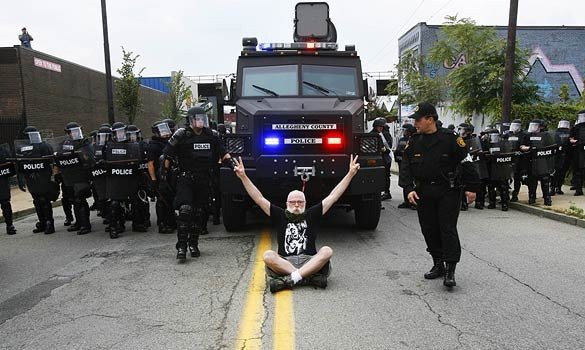
The year 1997 also brought along an updated program, known as the 1033 program (created under the National Defense Authorization Act). This program essentially allowed for the United States Department of Defense to transfer military-grade gear to civilian law enforcement agencies across the country because of the Iraq and Afghanistan war winding down. Through this program, agencies (including ferguson-area authorities) were able to acquire heavy body armor, semi-automatic rifles, armored vehicles (MRAPS and BearCats), grenade launchers, riot gear, tear gas, wet weather gear, and blankets (Fox & Cook, 2014). Through this increase in military style equipment, law enforcement agencies starting using them on a daily basis in order to maintain law and order on city streets. Even though officers use a lot of the equipment for their own safety (officer safety), they have been seen to use it incorrectly and inappropriately. As the Ferguson events were unfolding, the whole area had been on high alert which prompted authorities to shown in force. However, the only problem was many of the protests at the beginning were peaceful and really only needed a uniformed police presence (without the military gear and warrior mindset) to monitor their constitutional rights of free speech, as well as the right to assemble peacefully. After this chaotic scene of what seemed like the people vs. the police, the Department of Justice released their report on the Ferguson Police Department. The DOJ expressed that the police agency had handled the situation in the wrong manner (Reilly, 2015). They described that scene where police snipers were on top of armored vehicles, pointing their weapons at the crowds of peaceful protesters (Reilly, 2015). Many in the community saw these officers as attempting to intimidate and threaten the public they are meant to serve (Reilly, 2015). It’s very hard to understand that the men and women who swore to protect and serve are the same one’s seen on images and video’s already in confrontational tactical positions, as if they are ready to strike protesters (who want to freely express their opinions so that society can advance) at a moments notice. Police are meant to diffuse situations and have taken on the role of solving problems that get in the way of peace. However, recently in our history we have seen those in police uniforms escalating confrontations with their equipment, tactics, and demeanor (Baker, 2011). By playing the role of a warrior in the streets, it really hinders the chance to build ties with the communities they are meant to serve.

America’s law enforcement agencies have such an essential role in protecting and serving the people of the United States. Along with their role of making sure communities feel safe, they are also meant to facilitate protesters who have the right to the freedom of speech, and to assemble peacefully (Library of Congress). However, recently we have seen an increase of the militarization of our police departments, that have infringed people’s rights and civil liberties (especially those who are protesting). When you have peaceful protesters lined up, the officers job should be to dress in non-riot gear, but should instead have it in their cars on hand (in case things get out of hand and escalate). The image of officers lined up in heavy gear with assault rifles presents an extreme intimidation (especially to the majority of protesters who are there peacefully) and causes an escalation of the protests to become violent. Even though officers claim that the paramilitary style tactics and military model help with deterrence and officer safety, it doesn’t help with building community ties; especially when those paramilitary groups seem to be up against the majority of the community. This is not to say that we shouldn’t have paramilitary groups (heavily armed officers) since those special units are needed for emergencies. The men and women who are placed into these specialized groups should be trained well to balance stability and order, along with respecting the rights of individuals. These paramilitary groups should be used as the last resort (when situations escalate) so that the community knows police diplomacy was tried; but failed.

  1. At what point in situations do police need to resort to militaristic approaches? Should tear gas and rubber bullets be used to disperse crowds?
  2. From the events of Ferguson, do you think the police in the area infringed upon the masses civil liberties and constitutional rights?
  3. How does a police officer balance officer safety while not infringing upon individual’s civil liberties and individual’s rights?
  4. At what point does an assembly of protesters become unlawful? Do police departments have too much discretion at declaring an unlawful assembly?
  5. Do you think the police are seen as more of oppressors or people looking out for public safety?
  6. After thinking about Ferguson, Occupy Wall Street, and other movements, should police departments keep military gear/ vehicles on hand? Should this military gear be made visible to act as a deterrent to those wanting to cause harm? Do you think we should have the 1033 program still in place (considering police agencies get the proper training)?
  7. Do you think America’s police force (local, state, and federal) has the most militaristic approach towards crime compared to other countries?
  8. Do you think there is any situation where you believe the militarization of police should be used immediately; as an immediate force of action (EX- Martial Law)?

Sources:

http://www.huffingtonpost.com/2015/06/30/ferguson-protests-police-response_n_7698548.html

http://www.dailynews.com/general-news/20120227/north-hollywood-shootout-15-years-later

http://www.nytimes.com/2011/12/04/sunday-review/have-american-police-become-militarized.html

http://www.thenation.com/article/paramilitary-policing-seattle-occupy-wall-street/

http://www.loc.gov/law/help/peaceful-assembly/us.php

https://www.aclu.org/issues/criminal-law-reform/reforming-police-practices/police-militarization

http://www.usnews.com/news/articles/2014/09/17/pentagon-1033-program-sends-surplus-military-gear-to-us-borders

https://s-media-cache-ak0.pinimg.com/236x/4f/77/22/4f7722ee1d6cf8afd9477356d5daf2f4.jpg

http://blackbarth.com/wp-content/uploads/2015/08/militarization-of-police.jpeg

http://www.motorcycleprofilingproject.com/wp-content/uploads/2015/08/police-militarization-585×350.jpg

http://www.davidicke.com/wp-content/uploads/2014/07/get-attachment-154-587×410.jpg
The Changing Face of Imperialism in the Coming Future

The Imperial model of governance is one that is almost as old as human civilization itself, only superseded in age by tribes and city-states. It is a political system that has changed faces and its technique of conquering a foreign territory for land, people or most commonly for its resources. Ancient Empires were confined to a certain geographic location due to a lack of sophisticated technology. These empires were some of the greatest and most celebrated in history; the Egyptian, Persian, Alexandrian, Roman, Chinese and the Inca empires are all remembered for great battles, great drama and the absolute enormity of their respective territories despite their limitations.

Enter the modern age, and imperialism dawns a new face and a far more efficient method of invading and incorporating territories under the domain of the ambitious European empires. With advances in technology, European governments were able to ‘leap across the pond’, and with gun’s, germ’s and steel were able to colonize almost any country that offered them economic benefit. From the 15th century to the 20th century this was an age known for European imperialism, with major players including, the United Kingdom, Spain, France, Russia, Prussia/Germany, Portugal, the Ottomans and some would argue the beginning of the United States imperial aspirations. Most of these empires would fall after the conflicts of WWII, as empires became too much work to maintain. With the fall of the old guard, two new contenders for world dominance emerged from the ashes of the 2nd World War.

Once the Soviet Union and her associates of the ‘2nd world’ were out competed by the US and her associates of the ‘1st world’ a new age of imperialism began again. This time, the United States became an empire by default as she was the ‘unchallenged hegemony’. The United States qualifies as an empire not in the most literal sense of being ruled by an emperor, but by two qualifying factors:


  1. An extensive group of states or countries under a single supreme authority

2. A policy of extending a country’s power and influence through diplomacy or military force.


These factors and implications are not meant paint the United States in being the the stereotypical evil force that we often associate with the Galactic empire, but rather by being the powerful country in the world, any use of diplomatic or military pressure on other countries in the interest of the US, its people or its economy is considered an imperial doctrine and action. While I detest the imperial systems of earlier centuries, due to the unnecessary violence and unapologetic actions taken incorporate territories, I find nothing wrong in the name American Empire is these are the qualifying factors. As a realist in international matters, I view the game of geopolitics as winner take all. The American government has a duty to its interests and its people to ensure that the promises of domestic tranquility, common defense, and general welfare as defined in the preamble of the Constitution.

However, America’s time in the imperial spotlight may be nearing a close. As corporations and China begin to invest and purchase land rights from Africa and other under developed nations, we may see a new face to imperialism. As of late the Chinese have been purchasing land rights from African nations in exchange for shotty infrastructure. “China takes our primary goods and sells us manufactured ones. This was also the essence of colonialism,” stated Lamido Sanusi, the governor of the Central Bank of Nigeria as reported in the Financial Times. We have also seen the rise of corporations, seizing land and hiring what are essentially slaves in the global south. As we watch in the future, America may soon have to share the title of Empire with competitors.


Questions:

Do you agree that America’s duty to her citizens and interest’s as more important than than to the international community? Do you disagree? Why?

Do you believe that the United States is a true empire or simply an empire by technicality?

Do you believe that there is a way that there is a way for America to not need to apply pressure on other states and still pursue her interests?

Is there a way to rid the world of imperialism and hegemony or are we forced to repeat this pattern?

Would you call the United States of America an empire?

References

         American Empire. (2014, July 3). Retrieved November 18, 2015, from
https://www.youtube.com/watch?v=ASSOQDQvVLU

          An Introduction to American Empire | American Empire |. (2014, June 22). Retrieved November 19, 2015, from https://www.youtube.com/watch?v=6fD7ew69wiI

          Okeowo, A. (2013, June 12). China in Africa: The New Imperialists? – The New Yorker. Retrieved November 18, 2015, from http://www.newyorker.com/news/news-desk/china-in-africa-the-new-imperialists
       Schroeder, P. (n.d.). Is the U.S. an Empire? Retrieved November 18, 2015, from
http://historynewsnetwork.org/article/123

       What if European Imperialism Never Ended? (2015, November 16). Retrieved November 19, 2015, from https://www.youtube.com/watch?v=UvSe4npu9A8


If you could reduce the number of future prisoners, would you?

In the few weeks that we have been in this class I can recall three incidents that have come to my attention involving K-12 students and law enforcement. Ahmed Mohamed was arrested for making a clock, essentially the 14 year old was too intelligent for his own good? After that incident, video of 16 year old Emilio Mayfield  being slammed to the ground by police officers after being struck in the face for jaywalking to catch the bus surfaced. In more recent news we have the student in South Carolina who was flipped out of her desk and thrown across the room by Deputy Ben Fields, who was called in after the student was identified as being disruptive to the class.

I understand that these are all very different circumstances but at the end of the day we have three teenagers having experienced unnecessary trauma of being handcuffed and hauled to a police station with fear and questions of self worth running through their heads. What does it say when you have been conditioned to believe that bad people, criminals, are the ones who get handcuffed and you are the one sitting in the back of a police car after being in a classroom?

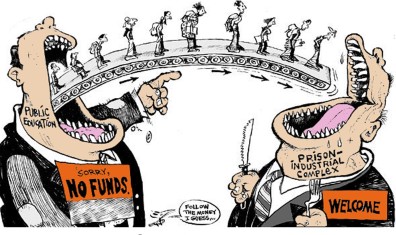
These incidents help visualize our far too intimate relationship between institutions of education and institutions of incarceration:

Heightened after fear of school shootings we have 82,000 school resource officers and security guards working in public schools (Brown). Not to say that the safety of students and staff should not be a priority, but what does it say when the students safety is put in jeopardy by the person who is their to protect them? Certain student and law enforcement encounters question the priority:

How do we justify a 5 year old with ADHD getting handcuffed with zip ties on his hands and feet, forced to go to the hospital for a psychiatric evaluation and being charged with battery on a police officer (Snyder)?

In the end the mother of 5 year old Michael Davis points out that rather than an apology she wishes her son had the proper education catering to Michael’s learning disabilities, the school didn’t offer behavioral services to Michael or his mother, because it would cost the district money.


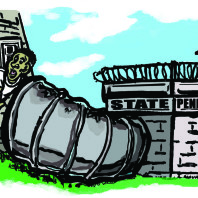
School-to-Prison-Illustration

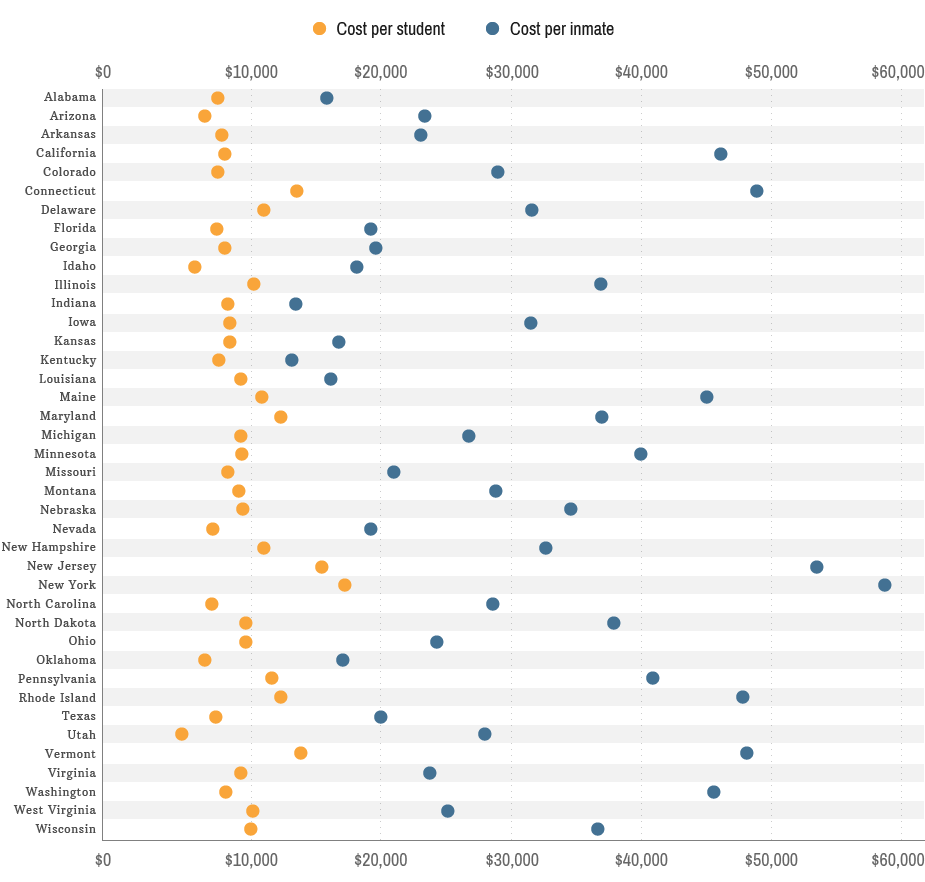
Education vs Prison Costs

Data from 40 states depict how much government money is spent per year to educate an elementary/secondary school student compared to the cost of keeping an inmate imprisoned.


Questions:

  1. After learning the mechanics of the school system feeding into the prison system, do you have an issue with more money being spent on prisoners than students?
  2. In this instance if we address the needs of the students, we would diminish the needs for prisoners by keeping them from becoming prisoners, so why don’t we prioritize education?
  3. Living in a time fearful of school shootings it seems as though police officers will not be leaving the classroom anytime soon. Does this leave us with a new field of criminal justice? Intro to policing K-12? Who takes on this responsibility, the college level, individual police departments, the school?


References:

“American Kids & The School-To-Prison Pipeline.” YouTube. Ed. AJ+. YouTube, 18 May 2015. Web. 11 Nov. 2015.

Brown, Emma. “Police in Schools: Keeping Kids Safe, or Arresting Them for No Good Reason?” Washington Post. The Washington Post, 8 Nov. 2015. Web.

School to Prison Graphic (I): http://mckpr.com/upload/prisonpipelinegraphic.jpg

School to Prison Illustration (II): http://www.suspensionstories.com/wp-content/uploads/2010/10/School-to-Prison-Illustration.jpg

Snyder, Michael. “19 Crazy Things That School Children Are Being Arrested For In America.” End Of The American Dream. N.p., n.d. Web. 31 Jan. 2012.

“Stuck In The School-To-Prison Pipeline.” YouTube. Ed. AJ+. YouTube, 20 May 2015. Web. 11 Nov. 2015.

“Taking Back Our Schools: Organizing to Stop the School-to-Prison Pipeline.” YouTube. Ed. Advancement Project. YouTube, 23 July 2013. Web. 11 Nov. 2015.

Yellin, Tal. Education vs Prison Costs. 2013. CNNMoney, n.p.

The Freedom to Find a Job; Prisoner Re-entry and the Struggle of Finding a Job

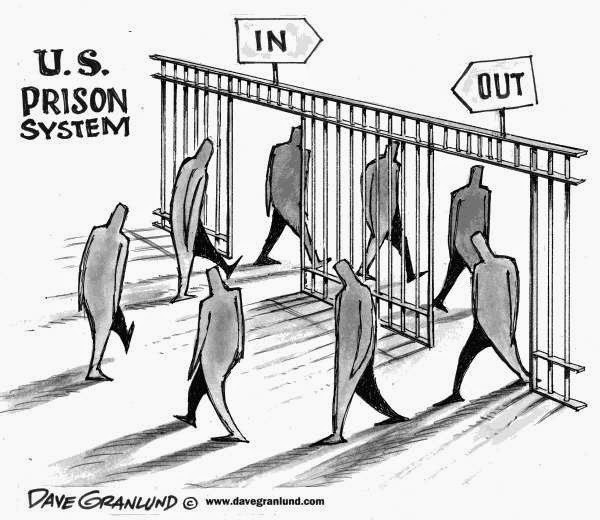
Prisoner reform is one of the biggest topics being talked about right now by the media and congress.  Once released from prison the recidivism rate for offenders is at a staggering high of 50%.  In NYC, 89% of offenders violate their prole who are unemployed.  60% of offenders do not hold a job a year after release.  Along with that 40% of offenders do not have a GED or high school diploma.  So how do we stop the cycle of recidivism?  It seems like common sense but people with jobs do far less crime then people with jobs.  If we want to reduce recidivism offenders need to be able to find and hold a job.  A lot of offenders though find it hard to find and hold jobs after being released from prison because of discrimination or not having the right education.  The system we have right now sets up offenders to fail.

prison-systems

How does this apply to Privacy, Security, and Freedom of Speech though?  If we were to fix these problems and offenders found it easier to get jobs that means we will have more offenders in the work place.  This could make a lot of people nervous and some people might not feel safe.  Employers are hesitant to hire people with criminal records because they are worried about the safety of their workers and how good of a worker they are.  One of the harder barriers that offenders have to overcome is filling out a job application.  In almost all job application their is a section where you have too fill out if you have been convicted of a felony.  Most jobs will throw your application in the garbage if you fill out yes you have and wont even consider you for the position.  On top of all of this there is a lot of jobs that have restrictions on hiring people with criminal records.  For a small amount of jobs this is not a bad thing but for majority of jobs a reformed offender is just like any person.  This creates a question of how much privacy should offenders get regarding to their criminal record.

Questions

1: Would you feel safe if you worked with someone who was once in prison?

2. Do you think that it should be legal to ask people if they have committed a felony on applications for jobs?

3. Should we bar people from certain jobs with criminal records no matter what their crime is?

4. Should the government help offenders find jobs after release?

Funny-Lizard-In-Jail-MEME-Jokes-2014

Sources:

Gideon, L., & Sung, H. (2011) Rethinking Corrections: Rehabilitation, reentry, and reintegration, Sage Publication, Inc.

.Immages:

https://www.bing.com/images/search?q=recidivism&view=detailv2&&id=8C55D8965A363A6360BF1E5357312941FE1E8F32&selectedIndex=5&ccid=9pvlQy9v&simid=607986122282632070&thid=OIP.Mf69be5432f6f1aab63a5c17f9e4632a4o0&ajaxhist=0

https://www.bing.com/images/search?q=lizzard+prisoner+meme&view=detailv2&&id=62CDA7A606B2225825564906F15A622C6D8EDD4A&selectedIndex=0&ccid=dWVQUR%2bi&simid=608012652293196082&thid=OIP.M756550511fa2e89e88323d270c843c3eo0&ajaxhist=0

Freedom of Speech, Opinion and Censorship

Freedom of speech is a gray area that often many are left confused with as controversial topics arise and test the limits of free speech. In a recent study, nearly 97 percent of self-proclaimed liberal college students found free speech to be important and 54 percent of those same students believed that the Confederate flag is deemed hateful and should be removed from public vicinities (Althoff, 2015). While many of these students have argued that free speech is a right, many surprisingly are more likely to support censorship, leaving confusion over what is free speech. As this survey was taken among 18-24 year old college students, many of the issues of free speech appear more commonly on college campuses.

Wharton college student Luis De Castro began to feel ostracized as word had spread that he was pro-life.  De Castro began to feel that “free speech is limited by the unwillingness of peers to consider the views of others” (Simon, 2015). A history professor from Wharton notes “a growing belief that everyone has the right not to be offended” is what is lending a hand in censorship across campuses (Simon, 2015). One important aspect is that when students attend college they are placed in a world where peoples’ views differ widely from their own and then learn how to deal with it without saying it is impeding on their free speech. De Castro is a “moderate conservative” and explained that people only cared about what his opinion was and not the reasons behind them. Due to this, people on his campus deemed him anti-woman and anti-contraception based on this one aspect.

Another article from Wesleyan University stated that a newspaper was to be defunded after an article about the movement Black Lives Matter was published and many protested against this article. In September, Bryan Stascavage wrote an article about Black Lives Matter arguing about the tactics, and those who are anti-cop. Stascavage’s article did not contain any racial slurs or name-calling, as is typical in such articles. After publication, students began to burn copies of the newspaper and Stascavage received remarks from students calling him “racist” (Rampell, 2015). An apology was published in the newspaper and stated the newspaper would be a “safe space for the colored community” (Rampell, 2015). However, this did not end the outrage as students petitioned to defund the school newspaper that had been present on the Wesleyan campus for 150 years. Stascavage was aware of the college and the majority of liberal views and sought it out to challenge his own views. The student government voted to cut the funding in half for the school newspaper.

Both of these instances happened at liberal colleges. Do you think this issue is restricted to these colleges where there is a majority of same viewed students or is it becoming more prevalent among other universities where people are more diverse?

When should you watch what you say?

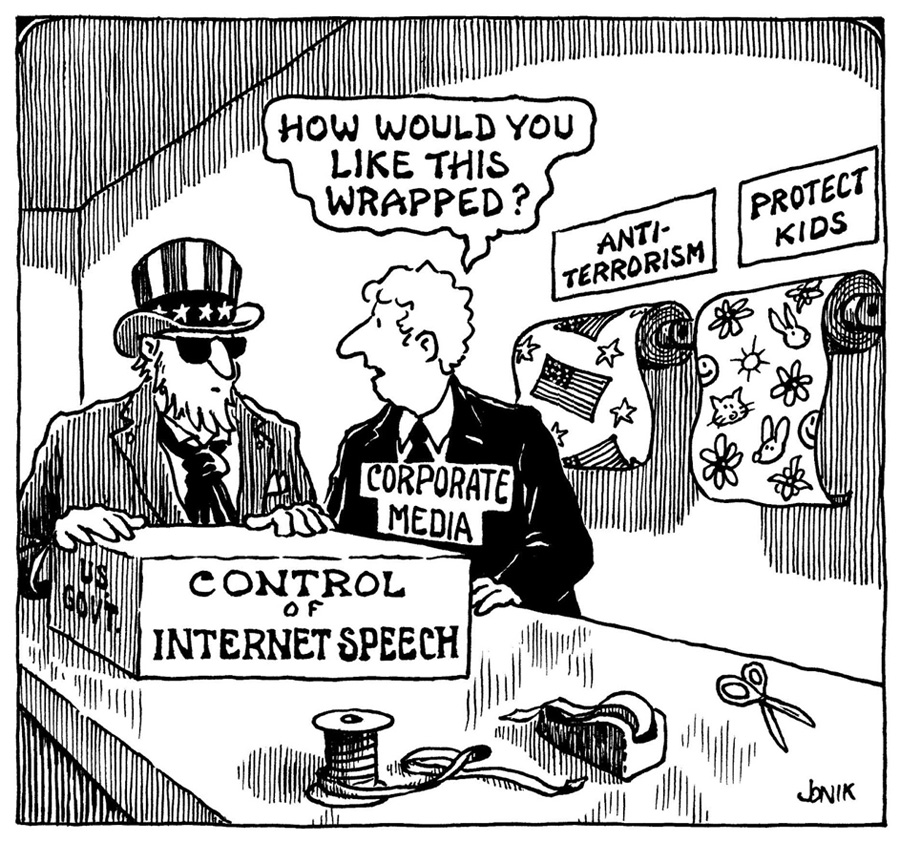
As social media becomes more prevalent in the world, the issue of internet censorship has become more controversial. A Freedom House study has found that 29 percent of the 65 countries Freedom House surveyed are “not free” while 27 percent are “free” (Fung, 2015). Attacks on newspaper Charlie Hebdo could be an explanation for the drop of France’s scores as government surveillance began shortly after. Cuba became more flexible, possibly due to the United States relations with Cuba allowing for cheaper Internet as U.S Internet providers are now allowed to do business there (Fung, 2015). Many tech companies have accused law enforcement of allowing the decrease in Internet security with the use of “back doors”, but authorities argued that this is to fight terrorism and crime.

How would you like this wrapped?

Social media websites are often privately owned and they therefore have the right to remove offensive comments or content that violates their terms and services. This has been confused with limiting one’s free speech, but rather it is censorship (Henry, 2012). Many companies believe it to be in their best interest to allow consumers to write reviews, both positive and negative as it can potentially contribute to future developments.

When should censorship be used?

What speech should be protected on the Internet?

References

Althoff, E. (2015, November 3). YAF study finds liberal students confused by concept of ‘free speech’. Retrieved November 4, 2015.

Fung, B. (2015, October 28). The Internet is getting less and less free. Retrieved November 4, 2015.

Henry, A. (2012, October 22). What Exactly Is Freedom of Speech and How Does It Apply to the Internet? Retrieved November 4, 2015.

Rampell, C. (2015, October 22). Free speech is flunking out on college campuses. Retrieved November 4, 2015.

Simon, C. (2015, October 30). Free speech at Penn: Protected by rules, limited by culture. Retrieved November 4, 2015.

Images:

http://www.londonlovesbusiness.com/Pictures/web/y/r/j/George-Orwell—quot_622.jpg

https://img.washingtonpost.com/wp-apps/imrs.php?src=https://img.washingtonpost.com/blogs/the-switch/files/2015/10/Screen-Shot-2015-10-28-at-14.16.33.jpg&w=1484

http://cdn.iwastesomuchtime.com/1302013182717.jpg

Police Shootings: What’s Our Current Rating?

Towards the end of 2014 and beginning months of 2015 it seemed as if police shootings were starting to become a more frequent occurrence. For several months, it was a consistency across all media sources, story after story. Currently, as of November 4th, (around 10 am), 829 people have been shot dead by police here in the United States, just this year alone.

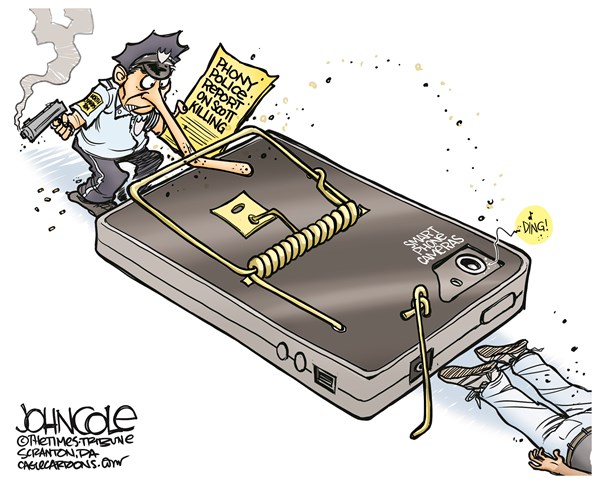
162570_600

With extremely advanced media technology today, these events have erupted across media sources in a matter of minutes. According to what gets placed into the news, it seems as if blacks are seen as the main targets for police shootings, seeing as it gets more attention. Surprisingly, that is not the scenario. Compared to blacks, whites are more likely to be killed by the police. Approximately, 48% (398) of those killed by police in 2015 have been a white person, whereas 25% (211) have been a black person. In comparison to states so far California (150) has the highest number of deaths on civilians caused by police. Here in the state of Washington 14 have been killed by police. To one’s surprise there are two states in the United States which have no record of a police officer killing a civilian (Washington Post, 2015).

policeshootingsgraph
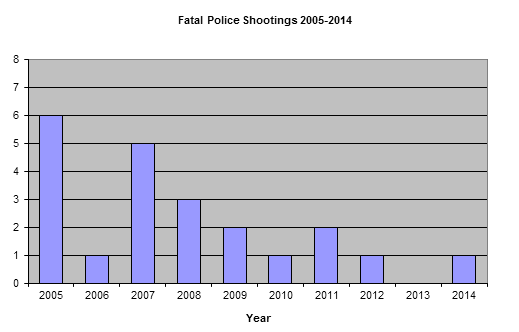
(England and Wales police shootings from 2005-2014)

Compared to other countries, the United States statistically rates enormously higher than the rest in the number of deaths caused by police. Police in the United States are taught to shoot center mass, whereas European countries police are taught to aim for the knee caps or shoot at the suspects’ feet; essentially wound and not kill the suspect. Also, some European countries do not allow for police to carry a gun. Without a doubt police work is a highly stressful profession, so not having some source of protection in a heated confrontation would be an uneasy scenario. So if some countries have been successful with this method, why is the United States not? As of June of 2015, England and Wales have had “55 fatal police shootings in 24 years, whereas in 24 days (from January 1- January 24, 2015), there have been 59 fatal police shootings in the United States” (Lartey, 2015). In some cases, the United States has had thousands of individuals killed by police, whereas some countries have only recorded a handful of deaths over fifty plus years. Another prime example is, here in the United States there has been over eight-hundred deaths of a civilian by police in just a little over ten months, whereas in the United Kingdom (England and Wales) has only recorded two deaths the entire year thus far. Just five months into 2015, in Stockton, California, “three people were fatally shot by police, however over 71 years Iceland has only recorded one” (Lartey, 2015).

152393_600

Questions:

  1. Do you think police shootings have risen over the past year or two?
  2. Why does it seem like police shootings have become a major issue in recent events? Could it be that once one shooting gets into the news, then it seems like that is all the media wants to display or talk about?
  3. If the United States were to change their police tactics to those like other countries (not aiming center mass for example), do you think the number of people killed by police would decrease?
  4. If police work is an extremely stressful profession, how is it that other countries are able to have such lower police cause deaths compared to the United States? Could it be a population differential? Could it be the militarization training and mentality of “shoot to kill?”


Sources:

Washington Post (2015). Retrieved: (November 3, 2015).  https://www.washingtonpost.com/graphics/national/police-shootings/

Jamiles Lartey. (June 9, 2015). “By the numbers: US police kill more in days than other countries do in years.” The Guardian. http://www.theguardian.com/us-news/2015/jun/09/the-counted-police-killings-us-vs-other-countries.  Retrieved: November 3, 2015.

Images:

https://www.google.com/search?q=police+lights&biw=1366&bih=643&source=lnms&tbm=isch&sa=X&sqi=2&ved=0CAcQ_AUoAmoVChMIi6ievtn3yAIVV_ZjCh3qWA0a#imgrc=dLbE4vk7NgF-bM%3A

https://dekerivers.files.wordpress.com/2014/08/152393_600.jpg?w=600&h=404

http://www.inquest.org.uk/statistics/fatal-police-shootings (graph)

http://media.cagle.com/20/2015/04/12/162570_600.jpg