Skip to main content Skip to navigation

Race and Gender in Our Perception of Mental Illness in Criminals


I’m sure you are all familiar will the Charleston shooting that happened in June this year. If not, here’s a summary of it from Wikipedia:

Emanuel African Methodist Episcopal Church in downtown CharlestonSouth Carolina, United States. During a prayer service, nine people were killed by a gunman, including the senior pastor, state senator Clementa C. Pinckney; a tenth victim survived. The morning after the attack, police arrested a suspect, later identified as 21-year-old Dylann Roof, in Shelby, North Carolina. Roof later confessed that he committed the shooting in hopes of igniting a race war.”

Source: https://en.wikipedia.org/wiki/Charleston_church_shooting
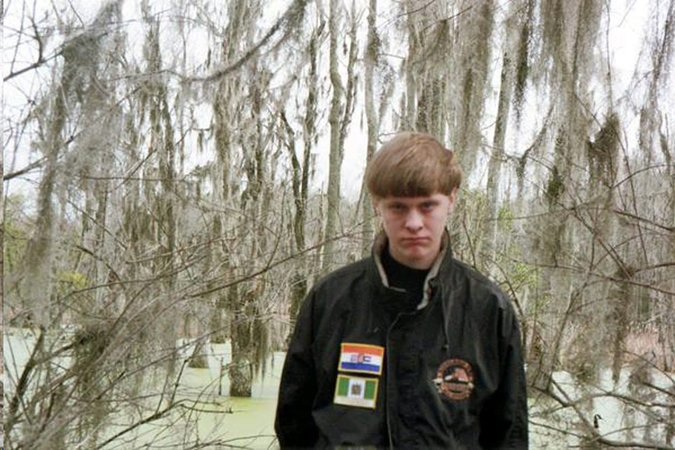
charleston-liveblog2-master675

Source: http://www.nytimes.com/2015/06/19/us/on-facebook-dylann-roof-charleston-suspect-wears-symbols-of-white-supremacy.html?_r=0

The media was quick to call Dylann Roof “mentally ill,” claiming he needed help. Do a quick google search and at least half of the hits on the first page are questioning whether or not Dylann Roof is mentally ill. This isn’t to say that he didn’t have some type of mental illness, but if a black person was to commit the same crime, I doubt the media and society would have been so quick to call them mentally ill. They more likely would have been called criminal, a thug, a terrorist, or anything but “mentally ill.” So, did the media’s immediate assumption that he was mentally ill have anything to do with the fact that he was a white man? I think so, and so do a lot of others. Titles of a few articles on the topic after a quick google search were, “It’s Not About Mental Illness: The Big Lie That Always Follows Mass Shootings by White Males,” “Racism is Not a Mental Illness,” and “Shooters of Color are Called Terrorists and Thugs, Why are White Shooters Called Mentally Ill?” There’s clearly a lot of controversy over calling this young man mentally ill right off the bat. Is this a problem for you?

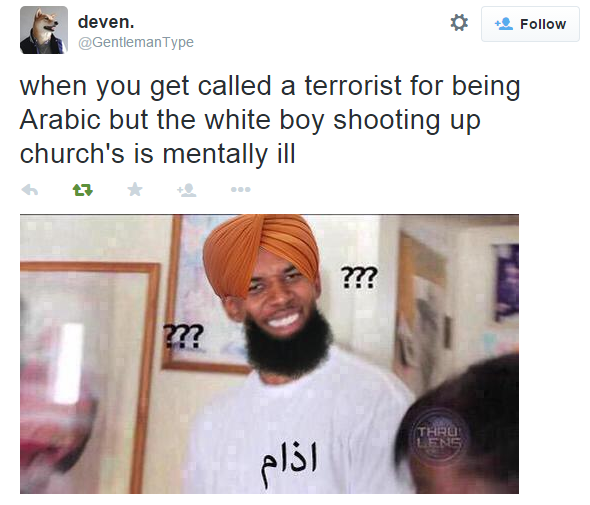
Take a look at some tweets shared by people who were against labeling Dylann Roof as mentally ill right after this tragic event (keep in mind – this isn’t about whether or not he was later found to have a mental illness, because yes, obviously white people can have mental illnesses…This is about the media and society’s immediate jump to call him mentally ill based on his race and gender).
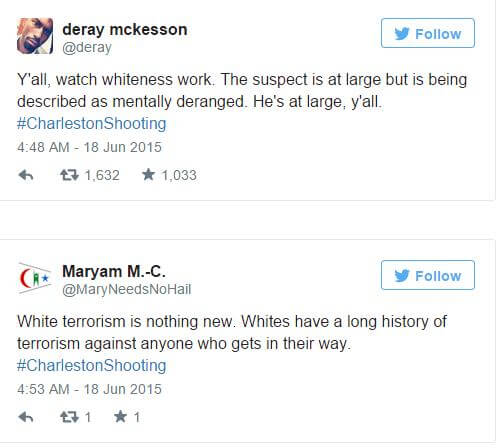
charleston

Source: http://beforeitsnews.com/blogging-citizen-journalism/2015/06/charleston-shooting-the-common-thread-isnt-race-its-godlessness-2512990.html
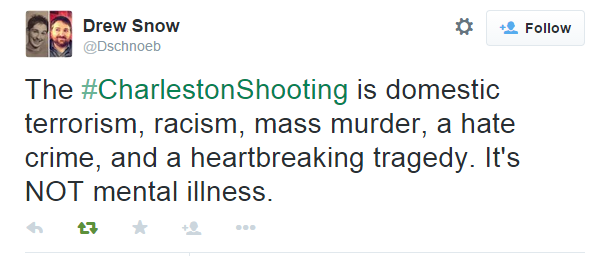
Screenshot-34

Source: https://twitter.com/dschnoeb

Screenshot-35

Source: https://twitter.com/gentlemantype/status/611507589503807490
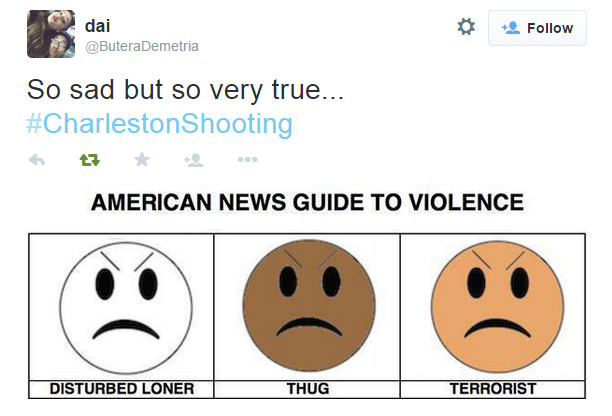
Screenshot-38

Source: http://site.cisternyard.com/2015/06/20/social-media-proves-that-racism-is-still-alive-in-2015/

This topic led me to do a little research and think a little deeper about how race and gender may affect our perceptions of mental illness, and how this can affect people in the criminal justice system.

According to the US HHS Office of Minority Health, black people are 20% more likely to report that they have serious psychological distress than white people. This is because they are more likely to live in poverty and crime ridden, violent areas. Even then, they are less likely than white people to be assessed for mental illness after committing a crime. According to “Gender, Race, and Mental Illness in the Criminal Justice System,” (Melissa Thompson, link: http://community.nicic.gov/blogs/mentalhealth/archive/2011/03/02/gender-race-and-mental-illness-in-the-criminal-justice-system.aspx)  “Violent women, for example, are more likely to be evaluated for psychiatric conditions, while African-American men are less likely to receive psychiatric evaluation.” This quote is in reference to the courts, where it is decided whether or not a criminal should be evaluated for mental illness or if they should just receive punishment. I think, and most people would probably support this, that minorities are more likely to be considered “thugs” or “terrorists” before and after committing crimes, whereas whites are more likely to be considered “disturbed” or “mentally ill.” In addition, I think that women are more likely to be perceived as mentally ill than men are. These biases can have serious effects on a person’s life after they commit a crime. Consider a young teenage black boy who has grown up in poverty. His mother is addicted to drugs and his father was shot and killed a year ago. All of his friends and older siblings are involved in a local gang. In these conditions (or similar conditions), which are a reality for many minority youths in America, it is easy to see how a person could develop some type of mental illness. Instead of considering the environment these people grow up in and may be involved in, society just chalks these individuals up to be violent criminals when a crime is committed. But when a white person commits the same crime, we are more likely to consider them disturbed or mentally ill. Even before a person commits a crime we may have biases that lead us to believe if they will or will not commit a crime, and if they did, what their motives behind it may be. If a person is genuinely mentally ill and this was the story behind their crime, but they are seen as simply a criminal, they may not be referred to psychological evaluation and just given punishment. This type of person (and probably society, too) would definitely benefit a lot more from mental health treatment, but instead they may be locked up. Also, since women may be more likely to be considered mentally ill after a crime, and men may just be brushed off as criminal, this could leave men without the proper care and treatment they deserve if they are truly mentally ill. This could also send a woman into mental health treatment when in reality she just deserves punishment. Yes, women are more likely to have a mental illness. Minorities are also more likely to have a mental illness because of the poor conditions they live in. So, in this case, are mentally ill women receiving more of the treatment they need after criminal acts than men are? Are minorities not receiving the treatment they may need if they are written off as “thugs” or “terrorists?” If so, does this perpetuate sexism against both genders and racism against minorities? Just because men are less likely to develop a mental illness does not mean that they cannot develop one.  Also, just because the majority of people living in poor, impoverished conditions are not white does not mean that white people cannot develop a mental illness. These biases that history, society, and the media have created are contributing to an unequal justice system that isn’t getting everyone the care and treatment they may need, and possibly forcing people into psychological treatment that they DON’T need. We may be locking up people who are truly mentally ill who would benefit a lot more from treatment, and we may also be passing off people as mentally ill when they aren’t. Race and gender should have nothing to do with referrals for mental health treatment or who society views as mentally ill or simply a “thug” or “terrorist,” but unfortunately they do.

Questions:

Are we more likely to assume some offenders are just mentally ill after committing a crime over other offenders because of certain biases we hold? Consider race and gender. What might some of these biases be? Why do we have these biases in the first place? What role does the media play in creating these biases? What role might history play?

Who is in charge of deciding whether a person should be assessed for mental illness or simply given punishment after a crime? Is this just the court’s job? Does society’s opinion on certain races and genders affect the court’s view on whether or not a person deserves to be evaluated for mental illness?  Do we need to consider the individual’s living conditions and surroundings when deciding whether or not they deserve mental health evaluation?
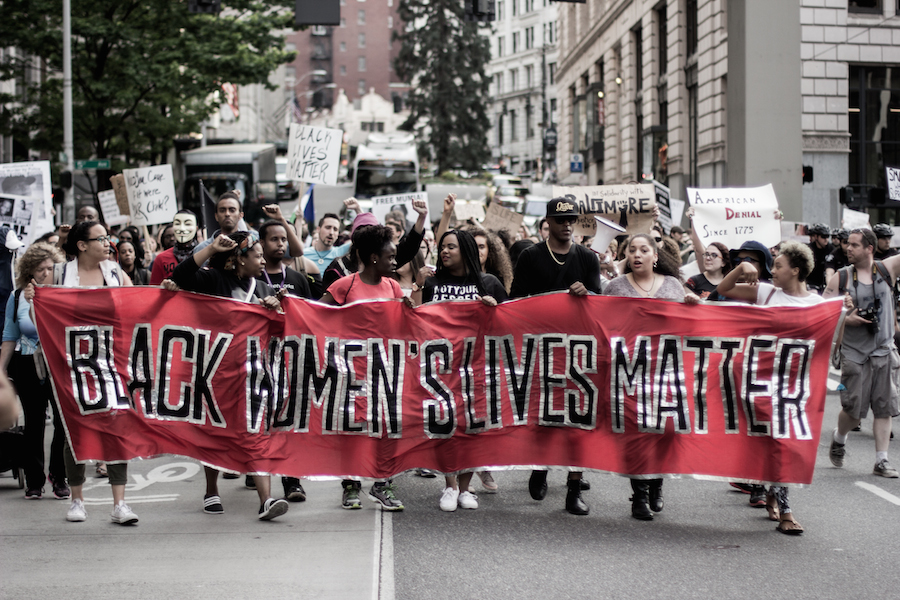
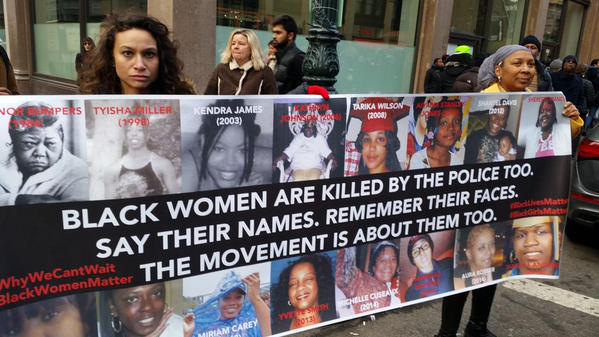
Black Women’s Lives Matter Too: the challenges of violence African American women face in home and in society

BLM-13

[http://sgmain.theseattleglobal.netdna-cdn.com/wp-content/uploads/2015/06/BLM-13.jpg]

Being a woman of color in the United States is a challenging position for the fact that not only do these women experience racial discrimination by society but discrimination for their gender as a female. African American women make up eight percent of the U.S. population, yet they are over represented in American jails and prisons as well as over resented in statistics of violence and abuse.

As we know, racism is the systematic discrimination of those outside the majority group believing that they are less than the majority due to certain characteristics. Sexism is the systematic discrimination of women based on their sex. Mix the two together and being an African American woman in American culture results in unreasonable amounts of harm, which we can evidently see today.

Earlier this year in June [2015] a video taken in McKinney, Texas of a police officer using excessive and inappropriate force on a fifteen year African American girl at a pool party went viral. In the video you hear the young girl crying for her mother and her begging him to “leave her alone”. What started all this was when a group of African American youths at a pool party were being called degrading terms by the white adults who were using the pool that day too. After much defense from several of the African American girls, an older white woman smacked one of the girls and the police were called to the scene. What happens when the McKinney Police respond can be seen in this uncensored video:

[http://www.attn.com/stories/1939/mckinney-pool-party-officer-casebolt-resigns]

As it can be seen, Officer Casebolt makes all the African American males drop to the ground with their hands in the air or out where he can see them, even to those who talked back to the officer. He then proceeds to fulfill his ego by using excessive and inappropriate force on a fifteen year old girl in her bikini. As it can be seen in the video, she is standing there and he grabs her, throws her to the ground, pulls a out his gun, and victoriously mounts her with his knee. Did he use that kind of force on the males who based on their height, age, and weight in comparison to the fifteen year old girl would clearly oppose a more serious threat? No. He dominated her because he could. By doing so he showed her and everyone his power, just to fulfill the image of masculinity and as the superior race.

black-women-lives-matter

[http://thesexysinglemommy.net/wp-content/uploads/2015/05/black-women-lives-matter.jpg]

The term violence toward women is fairly broad. What comes to mind for most people is sexual violence and assault, which is a fairly large aspect to the concept, but violence toward women can physical, verbal, emotional, psychological—anything that is meant to degrade a woman and make her feel less than a man just to hype up his ego and feel powerful is a form of violence toward women. The National Crime Victimization Survey (NCVS) reported that more than a third of the African American women report cases of violence at some point in their life. In the book, “Arrested Justice: Black Women, Violence, and America’s Prison Nation” by Beth E. Riche (2012), it displays the issue of violence toward African American women where we are not only seeing excessive force and borderline sexual assaults by police officers on these women but we see a large numbers of domestic violence/ intimate partner violence (DV/IPV) cases reported by African American women. It is reported that the second leading cause of death for African American women, ages fifteen to thirty-five, is homicide by an intimate partner (25-26). Time magazine mentions that African American women are an easy target for discrimination due to their racial status and gender. What makes them more susceptible for intimate partner violence is the fact that on average African American women make less money than white men and women, and African American men leading them to sometimes stay in bad relationship for financial stability and providing them with a sense of inferiority. And for those who do seek help, some are not granted the help they need. According to the ACLU, it was noticed that a high number of DV/IPV cases went reported in Detroit but not a thing was done by the  Detroit Police Department to help the victims; most of which were African American women. The complete lack of care the police have for cases of DV/IPV, especially when an African American woman is involved, is saddening. This theory is even further cemented in another case presented by the ACLU from Pennsylvania where an African American woman by the name of Lakisha Briggs was mandated an eviction notice by the police because her case of “domestic violence” was a best fit for a “public nuisance”. She was even stabbed by her intimate partner! If the police, the protectors of the people and followers of the law, cannot value the importance of violence toward women regardless of their race, it is impossible to see change and a better future for African American women and women everywhere.


Question Concerning Violence toward African American Women:

  1. What makes African American women more susceptible to discrimination by police? What threat do they pose? Is it a race thing, a gender thing, or both?
  2. Why do men use violence against women in general? What are the motives? Why do African American women experience such high levels of violence in comparison to their white counter parts?
  3. Do you think race plays into whether police respond to DV/IPV cases?


Sources:

Jones, F. (2014, September 10). Why Black Women Struggle More With Domestic Violence. TIME Magazine.

Leveille, V., & Park, S. (2015, August 7). Black Women and Black Lives Matter: Fighting Police Misconduct in Domestic Violence and Sexual Assault Cases. Retrieved September 28, 2015.

Richie, B. (2012). The Problem of Male Violence against Black Women. In Arrested justice black women, violence, and America’s prison nation. New York: New York University Press.

Race as it Pertains to Police Brutality in the United States

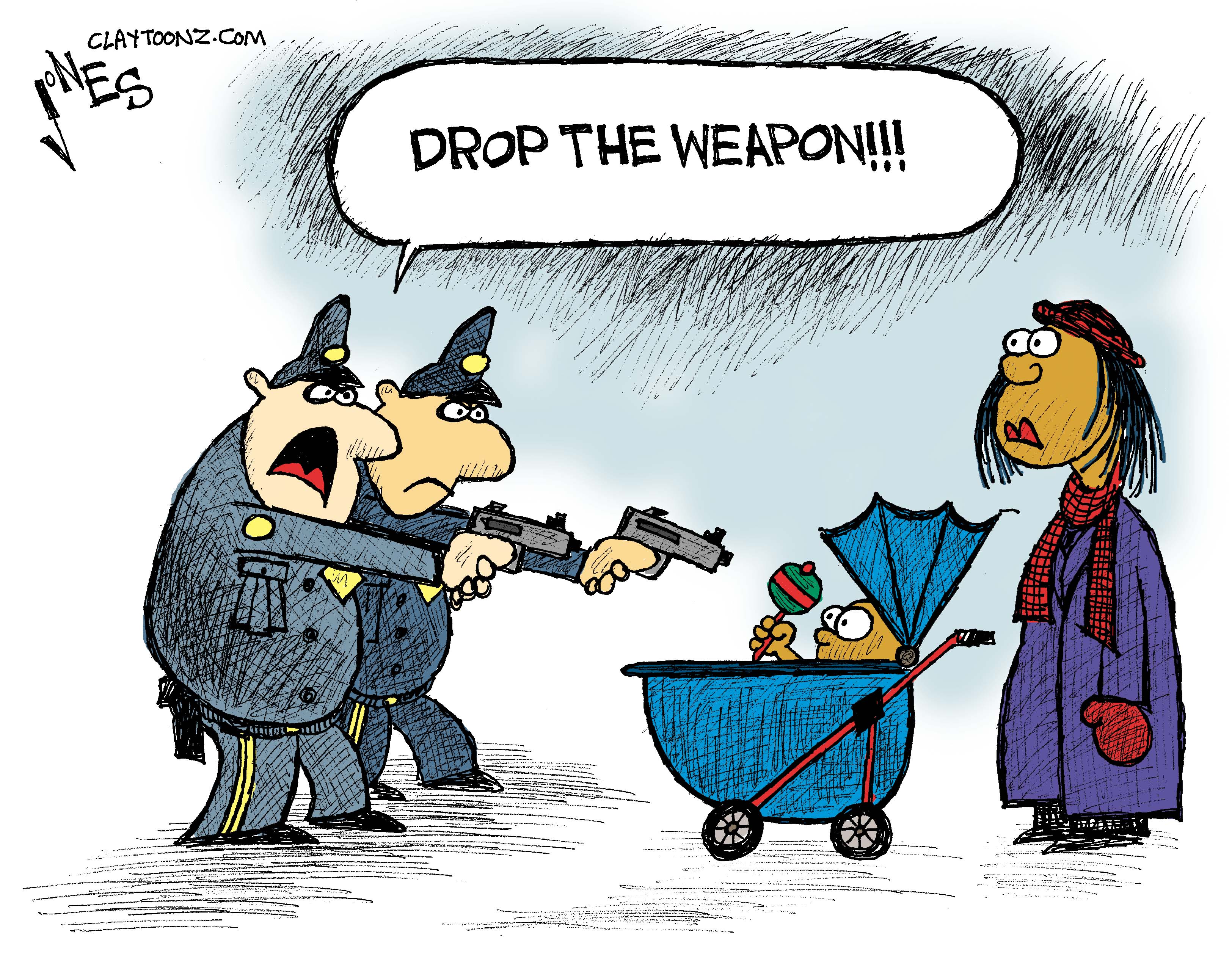
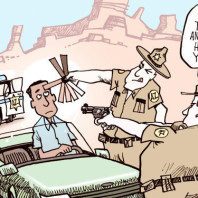
Increasing public awareness of police misconduct, primarily the use of excessive force or “police brutality” against unarmed Blacks, has sparked outrage amongst many communities throughout the United States. Reinvigorated in the early 1990s by the ferocious beating of Rodney King and perpetuated by the fatal shootings of unarmed teenagers Trayvon Martin in Sanford, Florida and Michael Brown in Ferguson Missouri, activist movements such as “Black Lives Matter” have been established throughout the United States. These movements campaign against police brutality; specifically what they perceive to be the wanton use of excessive physical force against Black citizens. Compiling the total number of fatal shootings by police since May 30th, 2015, The Washington Post found that although Blacks represent only 14% of the total U.S. population, Blacks accounted for more than 27% of victims fatally shot by police so far in 2015. Victim over-representation was not found for Hispanics or Asians, although the 31 “unknown” race victims could sway results. Whites are especially underrepresented as victims of fatal police shootings relative to their percentage of the population, as Whites constitute around 63% of the U.S. population but only account for 46% of victims of fatal police shootings in 2015 so far. Considerably more striking when looking at the data from a racial perspective is that of the 62 victims or 16% of the victim total who were unarmed or found to be carrying a toy gun, around 66% were Black or Hispanic. Based on the data, Blacks seem to be perceived as more dangerous than Whites regardless of whether they have a gun or not pointing to a history of prejudice and racism. This could not have been expressed more clearly than in the Tamir Rice case. Cleveland police on November 22nd, 2014 shot and killed 12-year old Tamir Rice after a 9-1-1 caller reported a juvenile was playing with a gun that was “probably fake” in a nearby park. The gun did actually end up being a toy gun that his friend had given him to play with only minutes before he was pronounced dead.  After absorbing this data, consider this question:

cjones11292014

Picture Source: http://claytoonz.com/tag/cleveland/

  • What do you believe to be the cause of Black over-representation in victim data regarding fatal police shootings? (e.g., Blacks being targeted by their race, Blacks committing more crimes than other races).

https://www.washingtonpost.com/national/fatal-police-shootings-in-2015-approaching-400-nationwide/2015/05/30/d322256a-058e-11e5-a428-c984eb077d4e_story.html

A statistic Blacks are not over-represented in, however, and considered by many BLM activists as one of the leading causes of police brutality is their overall representation in law enforcement. According to a survey by the Bureau of Justice Statistics, Black officers constitute just 12% of local police officers. Even more troubling is the fact that many police departments do not reflect the demographics of the jurisdiction in which they operate. For example, Ferguson, Missouri where Michael Brown was shot and killed has a 29% white population and a 67% Black population yet only three of the 53-officer department or 5% are Black. There is a clear disparity between minorities in the community and minorities working in law enforcement, especially for Blacks. Such a disparity could be due to a lack of trust towards law enforcement by the black community. Blacks with criminal records also find it difficult to pass backgrounds checks and application tests required to join the police force. There is, therefore, disconnect between law enforcement and the communities in which they work as differences in culture between primarily white law enforcement and Black communities, more than likely suffering through poverty and its adverse effects, creates a divide between the two.

  • What types of policies or prerequisites should the Criminal Justice System enforce to substantially diminish the occurrence of police misconduct, especially towards minorities? What has already been done? Can anything effective be done?

http://www.wsj.com/articles/percentage-of-african-americans-in-u-s-police-departments-remains-flat-since-2007-1431628990

What could be considered even more bizarre is how these fatal police shootings typically begin as minor traffic violations such as traffic stops or domestic disturbances. Below are two cases that exemplify these occurrences.

  • Samuel Dubose:

https://www.washingtonpost.com/news/post-nation/wp/2015/07/29/prosecutors-to-announce-conclusion-of-probe-into-cincinnati-campus-police-shooting/

  • Eric Garner:

http://www.nytimes.com/2015/06/14/nyregion/eric-garner-police-chokehold-staten-island.html?_r=0

Question to ponder:

  • Do you believe that police brutality, especially towards minorities, in the United States is on the rise or are advancements in technology over the past decade (cellphone camcorders, police cameras, etc.) contributing to the increasing number of police misconduct reports.
    • Fact: More than 60% of Americans now carry video enabled mobile devices.

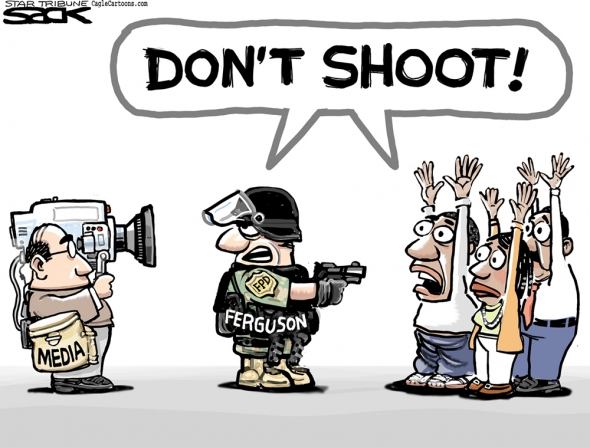
dontshoot_590_447

Picture Source: http://www.truthdig.com/cartoon/item/ferguson_police_20140826

Race and Class in the Criminal Justice System.

Does race play a role in the criminal justice system?

This issue is very important to me because I have experienced this on a personal level. I am not going to talk too much about that though. That is for another day, but the answer to that first question is that it is unanswerable. The reason why I said this is because every criminal justice system is different. The media only shows what they want to show. This makes it seem like the Criminal Justice system is cruel. Which it can be sometimes. For example, some of the most popular stories in the past 2 years or so include the Ferguson story, the riots in Baltimore, the “I can’t breathe” campaign. More recently, the shooting on the African-American church in South Carolina, Another major event that everyone is talking about is the case of Ahmed the 14 year old engineer. All these cases that I stated bring up the question on race. For example, If Michael Brown (Ferguson) was white would he have been dead right now? This question may never be answered. I can say  from experience that no one will truly know if race plays a role in the criminal justice system unless they actually go to court and observe a few cases. The cases that I listed above are just few of the thousands and thousands of cases heard in courts all over the United States per day. While i was interning at the Prosecutor’s office in Olympia, I observed only 1 case were I felt like race was an issue. All others were fairly fair and was based on their crimes.

justice


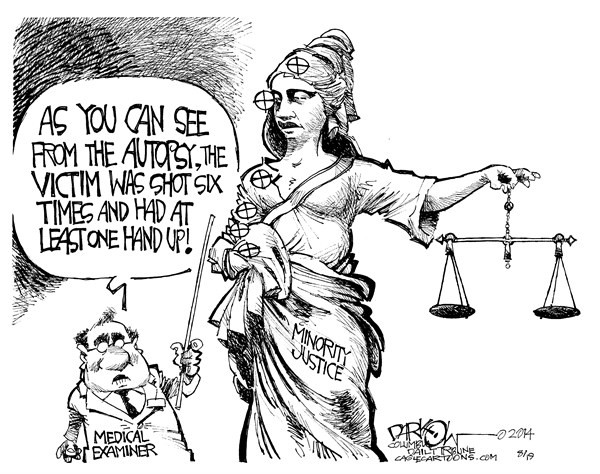
Picture Source: http://www.cagle.com/2014/08/lady-autopsy/

This picture describes what happened in the Ferguson case. This picture depicts what the justice system was thinking during the trial. On the other hand in the recent case with Ahmed Mohammad, he was let go after being arrested. Given that ‘he should not have been arrested in the first place.

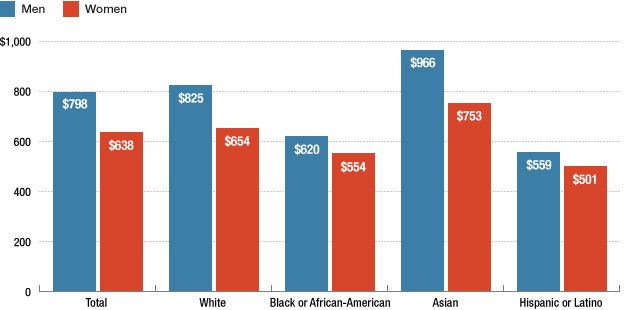
gr-race-earnings-624

Picture Source: http://www.npr.org/templates/story/story.php?storyId=125998232

The picture above depicts the average amount of earnings per race. Not only that, but it also depicts the difference between women and men. Just based on this, I did some more research and found some surprising or I guess not so surprising. The paragraph below describes my findings.


How about social class? Does race matter if an individual is in a higher social class? After spending 2 hours on this subject, I came to the conclusion that there is a small relationship. I say this because according to NPR.COM, the only racial group that earns more than whites is the Asian demographic. According to NPR.com the White demographic earns $825 for every $1,000 while the Asian demographic is at $966 for every $1,000. It is much lower for African-Americans and the Hispanic/Latinos. For example, the African-American demographic earns $620 for every $1,000 while the Hispanics/Latinos are making $559 for every $1,000. Ironically, The top two demographics who are in prison are the African-Americans and the Hispanic/Latinos. 1 in every 15 African American men and 1 in every 36 Hispanic men are incarcerated in comparison to 1 in every 106 white men.As for the Asians, they have 3,188 inmates in prison which makes up 1.8% of all inmates. This is according to the Federal Bureau of Prisons. Judging by this, Social Class does have a little bit of influence on this subject. Also, one thing that I noticed was that the crime rate was a lot lower in areas where the income was higher. It works the other way around too. Lower the income, the higher the crime rate.

Fun, but terrifying facts:

  •  Students of color face harsher punishments in school than their white peers, leading to a higher number of youth of color incarcerated 


  • According to recent data by the Department of Education, African American students are arrested far more often than their white classmates 


  • The war on drugs has been waged primarily in communities of color where people of color are more likely to receive higher offenses 


Question:

1.) Does race take part in the criminal justice system?

2.) Why does the media only show one side of the story.

Is Racial Discrimination a National Problem in the Criminal Justice System?


  Politics requires us to take a look at the big picture of current issues in order to solve them. Politics also considers similar historical evidence in much of its decision-making. In order to answer the question; is discrimination by race a national problem in the U.S., we need to look at some research. In Whitewashing Race, the Myth of a Color-Blind Society, Michael K. Brown and his associates presented three waves of social research that have been executed regarding discrimination in the Criminal Justice system. The first wave was implemented prior to the Civil Rights Movement, the results were that race did indeed have an impact in the system, such as in the courts and the police force. The second wave of research was completed throughout the 1970’s and 1980’s and was led by Alfred Blumstein of Carnegie-Melon University. Blumstein conducted research (with controlled variables) which compared African American rates of arrest for violent crimes with the imprisonment of African Americans. The results were this: “Blumstein found that about 80% of the difference between black and white imprisonment rates for crimes of violence had disappeared” (Brown, et al., 2004). The third and final wave mentioned in Brown’s article was done in the 1990’s and found that discrimination exists in the criminal justice system but in more indirect, complicated and sometimes subconscious forms. Why the sudden difference between wave 2 and wave 3? Robert Crutchfield can answer that question. Crutchfield pointed out that Blumstein’s national level of discrimination in the system did not accurately depict state rates (Brown, et al., 2004). There have since been several studies/research articles that confirm the theory that racial discrimination in the Criminal Justice system is a state-to-state problem, not a nationally universal one. This, of course, makes perfect sense since slavery was rooted in the South. Longstanding customs are culturally historic and some (like slavery) have an immense impact on the future. The three waves of research presented here tell us two important facts. One; discrimination in the system is declining over time and two: the problem is concentrated at the state level. Being aware of this problem is the first step, the next would be attempting to speed up the decline of discrimination until it is no longer a factor in our Criminal Justice System. To do this, I believe we cannot change the views of the people in our Criminal Justice System who discriminate unless we attempt to educate them. Just like many if not most people who discriminate, these offenders fall under the category of ignorance. Time too, I believe will aid in the dissipation of discrimination because these offenders soon will be discriminating against the majority, immigration will soon lead to a more racially neutral America.

Questions:

  1. Do you think the problem of discrimination in the Criminal Justice system is universally national or state-wide?
  2. What could be done to rid our Criminal Justice System of racial Discrimination in our states?


(Source: Upper Southampton Patch, 2015, “And the Most Racist Place in America is…Closer Than You Think”)

            Brown, M., Carney, M., Currey, E., Duster, T., Oppenheimer, D., Shultz, M., & Wellman, D. (2004). Whitewashing race: The myth of a color-blind society. Choice Reviews Online.

Retrieved from: https://learn.wsu.edu/bbcswebdav/pid-1044881-dt-content-rid-4509727_1/courses/2015-FALL-PULLM-CRM_J-400-7371-LEC/Brown%20et%20al.Whitewashing%20race2.Race%20crime%20and%20justice.pdf

How race and social class ties into mandatory minimum sentencing

For my blog I wanted to tie race and social class into mandatory minimum sentencing. Mandatory minimum sentencing laws are ultimately a set minimum sentence you have to serve regardless of the circumstances. This sentencing law prohibits any and all leniency from judges. No matter how small the crime is, whether or not you have a family, or even if its your first offense if it falls under the mandatory minimum sentence laws you must serve the time set for it. Majority of the mandatory minimum sentences apply to drug offenses, but some of the other crimes it applies to are possession of certain guns, pornography, and economic offenses in some circumstances. Another popular form of mandatory minimum sentencing comes from the three strikes law. For this law you have three strikes, commit two of them then on the third one you will face a specific minimum sentence for your felony. Similarly to mandatory minimum sentencing, the judge is not allowed to shorten the sentence no matter how small the third crime is.

Questions:
What is a better method of deterrence compared to mandatory minimum sentencing?
Do you think mandatory minimum sentencing was made to help the society or to hurt it?
Should judges have more input to cases regarding mandatory minimum?
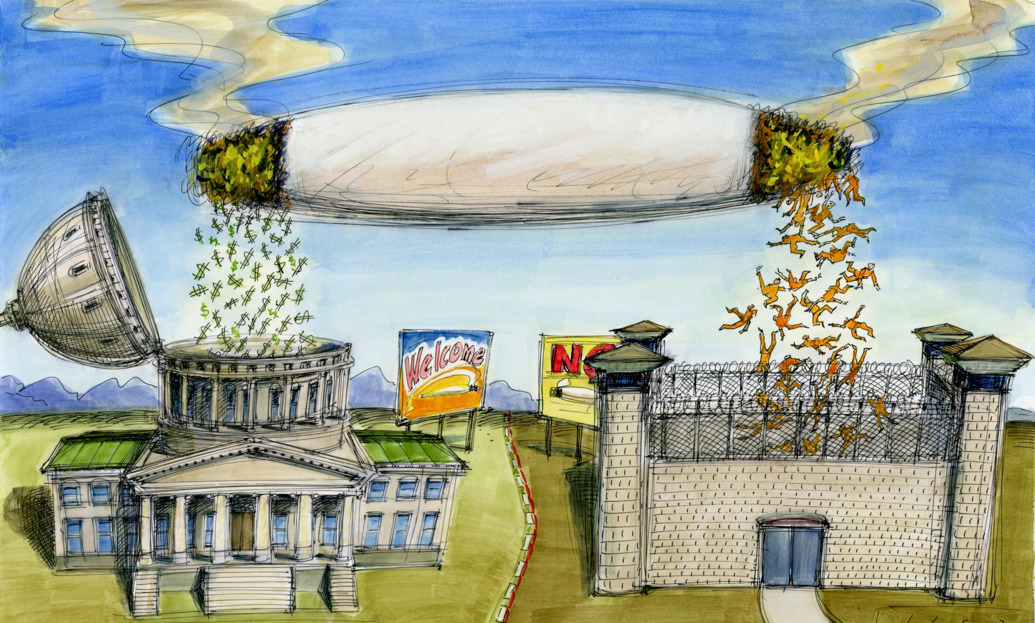
Are mandatory minimum laws effective or ineffective?1035x623-20140102-pot-laws-x1800-1388687052

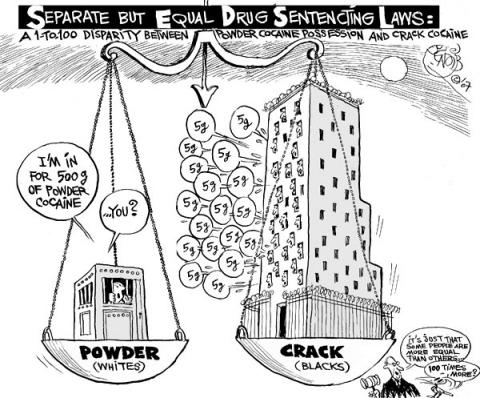
In regards to race, in 2011 Hispanic accounted for 38.3% of offenders convicted for a mandatory minimum penalty, while African Americans had 31.5%, Whites had 27.4%, and other races composed of 2.7%. When these men and women are sentenced to prison, they often leave behind jobs they had, spouses, and children. When things as such occur due to mandatory minimum sentence, their absence does not go unnoticed. The significant other is stuck raising a family struggling which is where social class comes into play. Anyone could be effected by mandatory minimum sentencing, it hit African Americans and other races much harder due to the circumstances. At the time the crack cocaine disparity was at 1-100 ratio. Meaning you could have this tiny amount of crack and get a high sentence when a person with cocaine could have a higher amount and get less or no charge. This applied to race in the sense that African Americans and people from the low class were purchasing crack because it was cheap and primarily white and upper class were purchasing cocaine which was the same thing but not condensed. This issue continued to spiral out of control and as times got harder and black unemployment rates increased, people looked for quick easy money which usually involved buying and selling drugs. Seeing how many individuals relied on selling drugs and ultimately ended up in the system, as mentioned earlier families truly suffered. Seeing how the head of household role was commonly empty because a mother or father could easily be imprisoned youth felt obligated to take on their role and would often do the same things their parents did for money.

Mandatory minimum sentencing is so strange to me. Like someone could commit all these off the wall crimes like kidnapping, assault, and everything else bad but their sentence could be less than an individual that had the smallest amount of drugs due to mandatory minimum sentencing. What’s really crazy is how marijuana is commonly recreational and legal and for countries and people are serving ridiculous sentences due to the mandatory minimum laws. It would be ideal for offenders to have the opportunity to plea their case to an organization or something and give them the chance to be released especially if it was their first offense. Mandatory minimum isn’t doing anything but over populating prisons honestly. The U.S. prison population has grown by almost 800% since the 1980’s. That being said, there’s no reason to not regulate use of drugs but perhaps give judges their discretion of reasonable sentences that are appropriate for their crime.

http://www.washingtontimes.com/news/2015/jul/14/obama-calls-for-overhaul-of-prison-system-end-of-m/?page=all
http://www.rollingstone.com/politics/news/the-nations-shame-the-injustice-of-mandatory-minimums-20141007blog picture

Picture Source1: “The Nation’s shame: The injustice of mandatory minimums”
http://www.rollingstone.com/politics/news/the-nations-shame-the-injustice-of-mandatory-minimums-20141007Picture Source2: “Reducing racial disparities in drug sentencing: an analysis of the fair sentencing act, 2015” http://blackwallstreetbooks.squarespace.com/ceo-blog/drugsentencingracialdisparaties

Social Class and the European Migrant Crisis

I wanted to tie my blog post into the international realm and take a look at class, criminal justice systems, and how we are reacting. The current migrant crisis that Europe is facing right now seems like the best place to start with that. This won’t be about just the criminal justice system for the countries involved. We’ll be speaking about what laws are at the forefront of the discussion, yes, but we’ll also be taking a look at topics more broad in scope. To start, here are a couple great articles that can bring you up to speed. I’m sure most readers are fairly up to date on this so feel free to skim the articles but pay attention to the various pictures and infographics throughout.


First, this top notch article from the BBC that does a great job using pictures to help you understand as well as outlining some potential solutions.

Second we have this New York Times article that talks about some hold-ups migrants are facing.


After reading (or skimming) those we should all be on the same page so lets delve into some major points and discuss the first major ‘law’. The BBC article mentions The Dublin Regulation. That’s a complex European Union Law that I’ll simplify here. Among it’s chief goals is to figure out what country is responsible for an asylum claim or in other words what country has to shelter migrants. The way this was working during the current crisis is most often the first EU country migrants reach receive the burden. This has placed enormous strain on countries like Hungary. I use the past tense because the Dublin Regulation has been suspended by countries like Germany and Hungary in direct response to this crisis. The Dublin Regulation is not strictly a Criminal Justice oriented law, however it does allow other member countries to transport migrants back to the country responsible for sheltering them. This crisis is pushing existing regulations to the breaking point.

The fact of the matter is that no existing laws are coping with this influx. The EU is scrambling to figure out a suitable course of action. Ideas range from using member country navies to cut off the sea routes and sealing the borders to taking a much more prominent role in ending the Syrian civil war to reaching out to the Gulf Arab Countries to aid in sheltering migrants. What the EU comes up with will likely have world altering effects. It’s worth staying up to date.

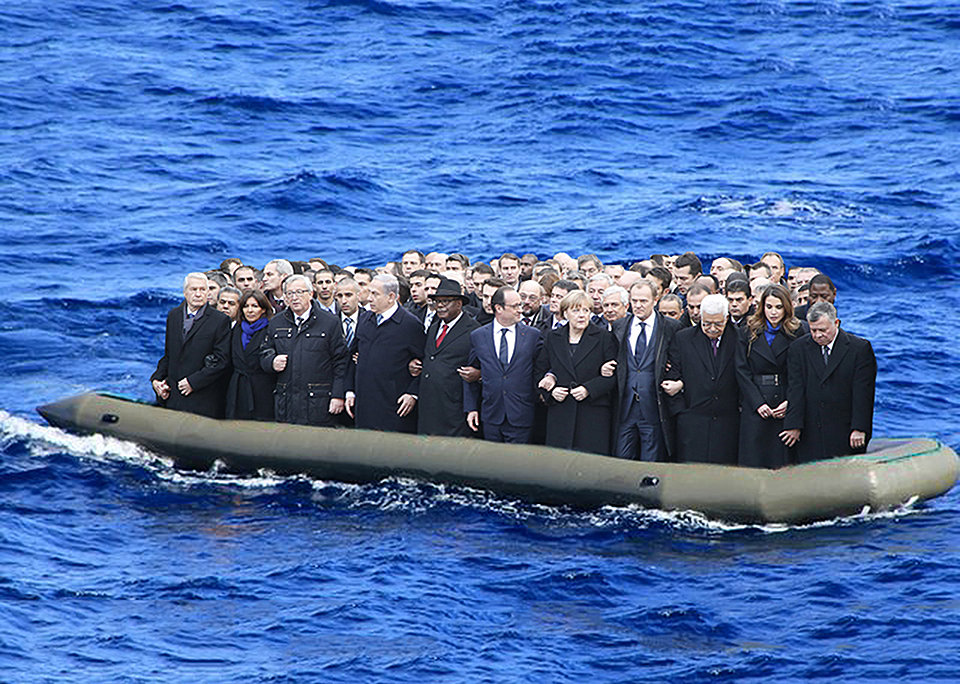
How does class play into this? I’ve got a great image to help answer that question. (Image Credit: http://www.walkerart.org/magazine/2015/natascha-sadr-haghighian-oped-refugees-eu)

EU-Raft

If those people seem familiar that’s because they likely are. If you didn’t recognize them right off the bat the people in that photo are high profile, some are even the leaders of countries. The attire of the people on the raft is in such contrast to the environment it’s comical. For me this really illustrates the class issue occurring. The migrants we are seeing are often in tattered clothes, bloodied, and have facial expression akin to despair. We don’t see the rich or elite fleeing in trucks, rafts, or various other means of transportation. Why? This photo brings me to the two questions (more like five) we should all be thinking about.

  1. Is class playing a role in this crisis? If yes, in what ways? If no, why not? Why don’t we see or hear about the elite dying as they flee?
  2. What are some ways the criminal justice system, and laws as a whole, could help ease the burden facing so many EU countries?

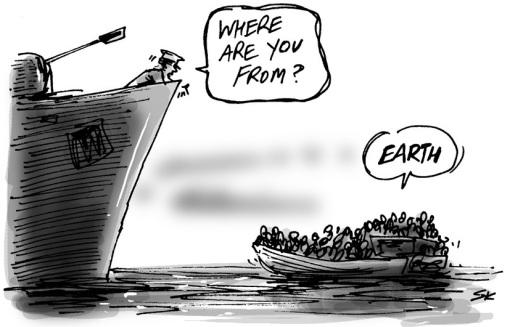
Finally, I’d like to leave you all with an image I think a lot of people have forgotten in the face of this crisis. (Image Credit: http://i100.independent.co.uk/article/the-cartoon-that-sums-up-the-worlds-migrant-crisis–g12atJpSWZ)

Earth


Featured Image: http://www.newzimbabwe.com/news-22062-Migrants+crisis+Why+Europe+misses+Qaddafi/news.aspx

Thumbnail Image: http://www.telegraph.co.uk/news/worldnews/europe/eu/11557074/Mediterranean-migrant-crisis-EU-leaders-meet-for-emergency-summit.html

Social Class & The Criminal Justice System

Does social class or status have an effect on whether or not a person is convicted of a crime?

If a person is convicted of a crime, does their social class or status factor into how severe their punishment is?

These are two very big questions that bring up some interesting points. Take for example the trial of O.J Simpson in the murder of Nicole Brown Simpson. Simpson was able to talk prosecutors out of potentially giving him the death penalty due to the fact that his “pockets were deeper” than those of the prosecution. Many people who are accused of murder are not able to so easily avoid the death penalty, regardless of their race. Despite Simpson being a minority (African-American), his social status was that of a celebrity, meaning he was very wealthy and had the means to adequately defend himself. Many defendants who are minorities do not have those types of means. This is also an example of social class being of higher priority than minority status. Simpson’s master status was clearly that of a celebrity, rather than an African-American, and therefore allowed him to receive special treatment. Because of the wealth and resources that Simpson and his legal team were able to accumulate, they were able to project reasonable doubt onto the jury, which lead to his acquittal. According to one of these articles, “systems of crime control socially construct selectively enforced and differentially applied norms to social groups, according to relationships of power, status, and authority” (Barak). This can be interpreted as the criminal justice system having the ability to decide the harshness or the form of punishment based on the authority, social class, status, or power of an individual, regardless of the crime committed.

Does this make for a “just” criminal justice system? Why or why not?

Here are two articles that discuss more about social class in the criminal justice system:

http://www.critcrim.org/critpapers/barak.htm

http://www.shfwire.com/class-and-race-play-role-criminal-justice-system-experts-say/

Also, here is a picture to illustrate wealthy social class privilege:

Social Class