McKenna Quirk
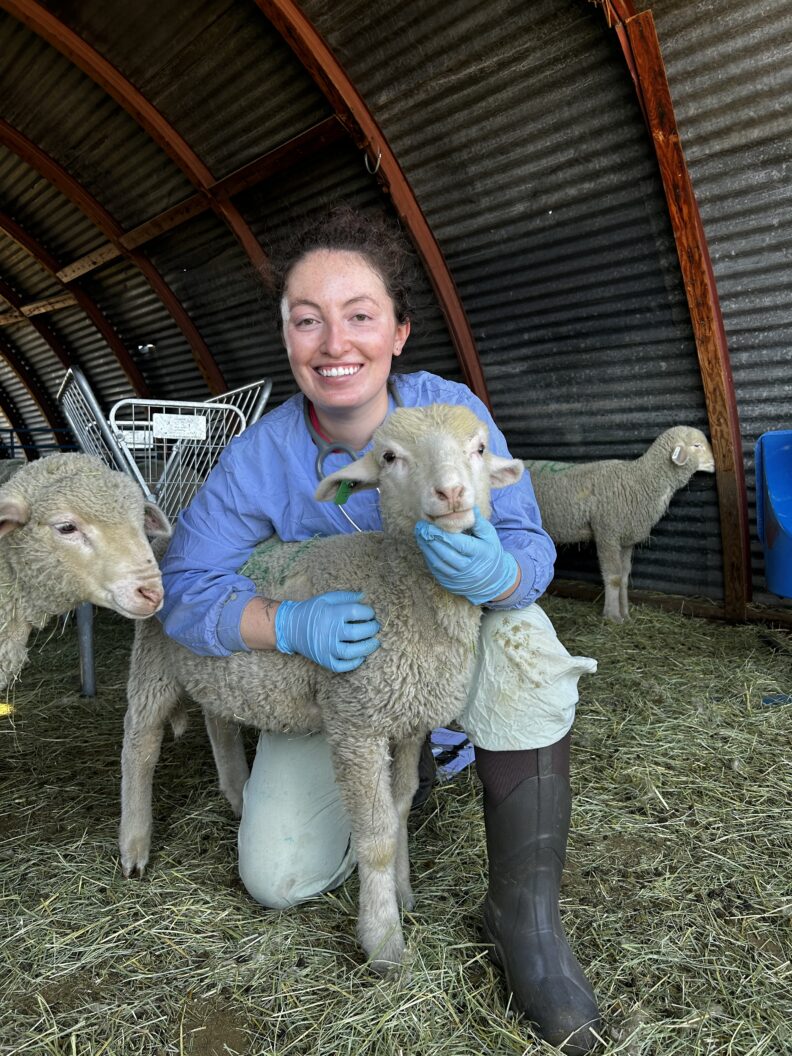
Hi, I’m McKenna!
I’m a DVM student from Montana and completed my undergraduate studies at Montana State University. I started the DVM program on the Montana campus as a member of the class of 2028. This is my first year as an ambassador.
I’d love to talk to you about Simulation-Based Education, the communications curriculum, club activities (especially wet labs) and conference and travel opportunities!
Areas of interest
- Equine (internal medicine & surgery)
- Rural mixed animal practice
- Large animal practice
- Research
Club involvement
- Integrative Medicine Club
- Internal Medicine Club (Secretary)
- SAVMA
- Student Chapter American Association of Equine Practitioners
- Small Ruminant Club
- Agricultural Animal Club
Extracurricular activities
- Simulation Based Education Peer Instructor
- Summer Research Fellowship
- Lambing shifts at University of Idaho
- 4-H outreach events
- Equine floating lab
One of my most meaningful experience in our program thus far has been the summer research fellowship that I completed after my first year of veterinary school. This experience showed me the impact that I can have on the field of veterinary medicine as a student. Our contributions to the veterinary field begin as vet students, and likely before during our undergraduate careers. This experience also allowed me to spend valuable hours completing physical exams on the lambs in our study, and showed me the key role that veterinarians play in research. I will carry the critical thinking, problem solving, and clinical skills I gained from this experience into my future as a large animal practitioner. Keep reading for more details about my research project!
The overall purpose of the study I worked on in Diane Bimczok’s lab at Montana State University was to formulate and test a biofilm-based M. ovipneumoniae (M. ovi) vaccine that can be utilized to decrease the prevalence of this pathogen in domestic sheep herds, improve overall herd health, and protect bighorn sheep populations from disease spillover. The economic impacts that M. ovipneumoniae has on the sheep industry, and the lack of effective antibiotic treatments necessitates the development of an effective vaccine. I worked with an established herd of specific-pathogen-free (SPF) domestic sheep for this project. The immunogenicity of the vaccine was analyzed utilizing serum, nasal wash, and bronchiolar lavage samples. In my summer research project, I focused on determining the safety of the vaccine through examining the lambs for adverse reactions, and assisted in the completion of experiments to determine the immunogenicity of the vaccine. This project culminated into a challenge experiment performed with the SPF herd to confirm the effectiveness of the vaccine formulation. While working in Dr. Bimczok’s lab that summer, I was also able to analyze data from a longitudinal study of chronic M. ovipneumoniae infection in a domestic sheep herd, and I was lucky enough to recently publish my findings in the American Journal of Veterinary Research.
One of the most impactful ways that our DVM program has prepared me for my future career is our communications curriculum. As veterinarians we will be talking to our clients and staff every day, and the way we communicate will be a cornerstone of our success as employers, teammates and doctors. Having the opportunity during my second year to practice talking with simulated clients, and practice giving and receiving feedback gave me a vast amount of tools that I will be able to use in practice every day. In addition to our communication curriculum, our simulation-based education department through which we learn surgical skills has helped me feel prepared both for my future career, and to be able to confidently perform basic procedures while completing externships.
Veterinary school gives you an immense number of tools and opportunities to help you build the career in medicine that you envision for yourself. At times, the sheer volume of opportunities available, whether it’s lunch lectures, wet labs, club events, research, or networking experiences, can feel overwhelming. I still find myself struggling to decide which opportunities are most worth my time and energy. What I wish I had understood before starting veterinary school is that there is no single “right” path. There are no wrong answers when it comes to choosing where to invest your time. Every experience teaches you something, whether it helps you discover a new passion, develop a skill, build connections, or simply learn more about yourself and the kind of veterinarian you want to become. Veterinary school is ultimately about growth, and your journey does not have to look like anyone else’s to be meaningful or successful.