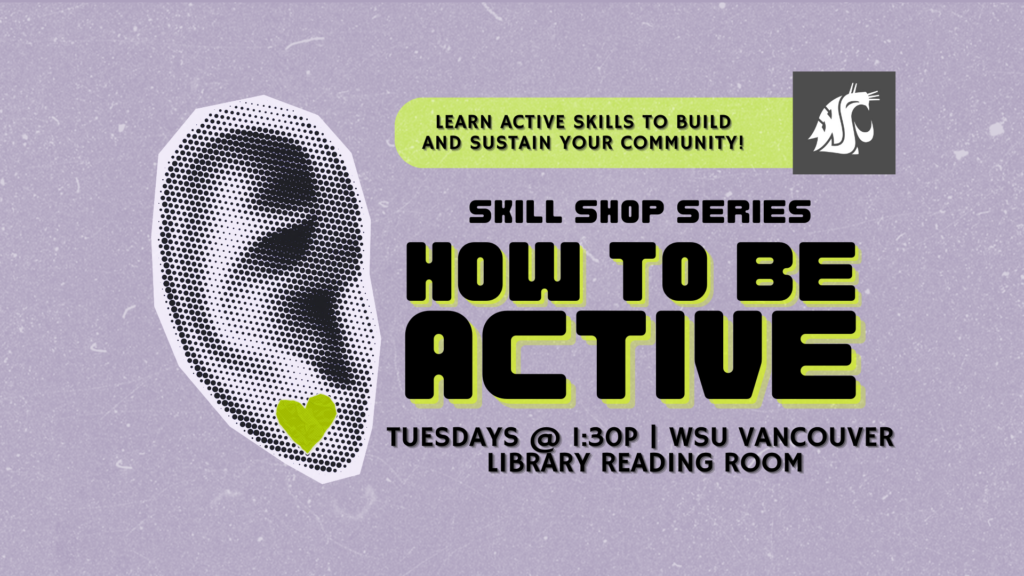
When is the Skill Shop Series?
When: Every Other Tuesday @ 1:30p in the WSUV Library Reading Room
Who: community members, students, staff, and faculty from Southwest Washington are welcome!
Active: engage in activities which involve mental, emotional, and/or physical movement as purposeful contribution toward community strength
Community: a group of people who share a common geographical location, interests, or values, such as students, staff, and faculty on a university campus, or residents in a town
Participation: the act of being actively, intentionally engaged and involved in something bigger
#How2bActiveWSUV
Skill Shop Series Schedule
Why a Skill Shop Series? Activating our Land-Grant Mission toward Community Support in Southwest Washington
- This Skill Shop series advances our land-grant mission to think about the ways we can democratize practical skills toward community-building for all.
- One of WSU Vancouver’s main goals is to maintain mutually beneficial community outreach, research, financial, and civic engagement partnerships. Our campus also seeks to contribute to the betterment of the community. (opens new tab)
- WSU Vancouver has been a leader in Southwest Washington for decades, and as a land-grant university, WSUV can be our region’s hub for practical community-based skill building and civic engagement.
Now is the accepted time, not tomorrow, not some more convenient season. It is today that our best work can be done and not some future day or future year.
W.E.B. DuBois
Goals & Objectives of the Skill Shop Series
- Stamp out apathy and powerlessness by inspiring active collaboration
- Skill shops to promote active community participation
- 1 hour Skill Shop: 20 minute Presentation + 20 minute Activity + 20 minute Reflective Discussion
- Skill shops will emphasize hands-on strategies to address current problems
- The Skill Shop Series will engage music and arts, as well as practical methods to build toward a better future for all
… science may have found a cure for most evils; but it has found no remedy for the worst of them all — the apathy of human beings.
Helen Keller, My Religion (1927)
A Quick History Lesson
Prior to the advent of public universities, college education was not available to most everyday people. In fact, higher education was almost exclusively available to the aristocracy: wealthy, white men whose families owned property—most of us would not have been part of the aristocracy. Educational segregation created real problems for many families’ ability to build wealth because access to networks, resources, and capital was reserved for a small subsection of society. The rest of us were left to make ends meet, but it didn’t have to be this way.
Morrill Act of 1862:
An Act donating Public Lands to the several States and Territories which may provide Colleges for the Benefit of Agriculture and the Mechanic Arts
- With land donated by the federal government, states established over 50 universities to provide practical education to the masses, with emphasis in agricultural science, mechanics, and liberal arts.
- Washington State University is our state’s designated land-grant university, founded in 1890.
- The First Morrill Act primarily benefitted the white public, however, and it was not until 1890 with the Second Morrill Act that the first Historically Black Colleges and Universities (HBCUs) were created.
- The Morrill Acts have been incredibly important for increasing educational access to the masses, but at the same time, they created a segregated education system.
“The tyranny of a prince is not so dangerous to the public welfare as the apathy of a citizen in a democracy.”
Montesquieu
Reading List
Almeida, Paul. Social Movements: The Structure of Collective Mobilization. University of California Press, 2019. (links to book)
Almeida, Paul. Mobilizing Democracy: Globalization and Citizen Protest. Johns Hopkins University Press, 2014. (links to book)
Applebaum, Anne. Autocracy, Inc.: The Dictators Who Want to Run the World. Random House, 2024. (links to book)
Ben-Ghiat, Ruth. Strongmen: From Mussolini to the Present. W.W. Norton & Co., 2020. (links to book)
Daniels, Ronald J., Grant Shreve and Phillip Spector. What Universities Owe Democracy. Johns Hopkins University Press, 2021. (links to book)
Han, Hahrie, Elizabeth McKenna, and Michelle Oyakawa. Prisms of the People: Power & Organizing in Twenty-First-Century America. University of Chicago Press, 2021. (links to book)
Levitsky, Steven, and Daniel Ziblatt. How Democracies Die. Crown Publishing Group, 2018. (links to book)
Levitsky, Steven, and Daniel Ziblatt. Tyranny of the Minority: Why American Democracy Reached the Breaking Point. Crown Publishing Group, 2023. (links to book)
McCarthy, Hannah, and Nick Capodice. A Users’ Guide to Democracy: How America Works. Celadon Books, 2020. (links to book)
Mettler, Suzanne, and Robert C. Lieberman. Four Threats: The Recurring Crises of American Democracy. St. Martin’s Griffin, 2020. (links to book)
Phelps, Johanna. Consequential Contexts: Principles for Effective Community Engagement in Technical and Professional Writing. Pressbooks, 2021. (links to book)
Posner, Eric A. The Demagogue’s Playbook. St. Martin’s Griffin, 2020. (links to book)
Richardson, Heather Cox. Democracy Awakening: Notes on the State of America. Penguin Books, 2023. (links to book)
Sage, Sami. Democracy in Retrograde: How to Make Changes Big and Small in Our Country and in Our Lives. Gallery Books, 2024. (links to book)
Spencer, Hastings, and Johanna Phelps. Principles, Practice, Praxis: Community Engaged Pedagogies at WSU Vancouver. Pressbooks. (links to book)
Stanley, Jason. How Fascism Works. Random House, 2018. (links to book)
Zinn, Howard. A People’s History of the United States. Harper, 2015. (links to book)
Contact
The How to be Active Skill Shop Series is sponsored by the Washington State University, Vancouver Library and the Department of History.
Should you have any questions, please contact Dr. Shiloh Green Soto at shiloh.greensoto@wsu.edu or Sam Buechler at sam.buechler@wsu.edu.